
What Are The Advanced Techniques In ABAP Programming And Core Data Services (CDS)?
4.9 out of 5 based on 14562 votesLast updated on 15th Apr 2026 28.8K Views

- Bookmark
Explore advanced ABAP programming techniques and Core Data Services (CDS) to build efficient, high-performance SAP applications. Learn best practices, optimization tips, and real-world use cases.
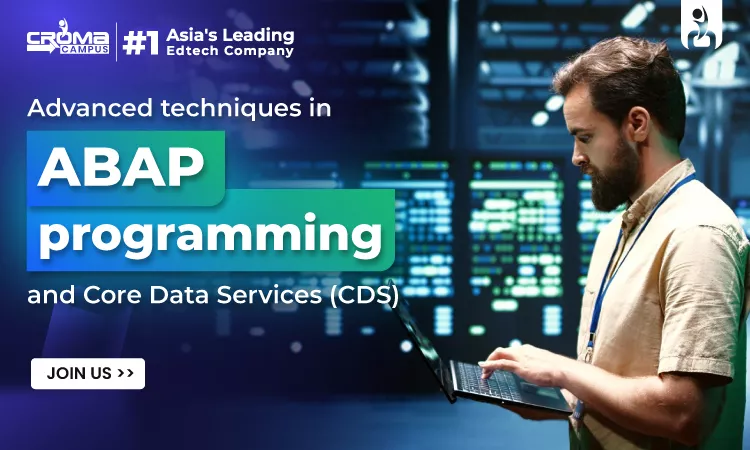
Day by day, various changes are taking place in the technical world, nd staying updated with the same is the only way to survive. For the people who are looking to grow in the field of SAP, especially with S/4HANA, need to understand how the coding side of things is changing. Well, the traditional ways of writing code have been completely replaced by the modern, as well as faster methods.
This is why applying for the SAP Course Online helps you learn better and to keep the skills relevant. In this article, we have discussed some of the advanced techniques in ABAP Programming and Core Data Services in detail. Over the last few years, these systems have shifted to the ABAP cloud. So let’s begin discussing this in detail:
Advanced Techniques in ABAP Programming and Core Data Services
Here we have discussed the advanced techniques in detail. Taking SAP S4 Hana Online Training can be a great way to learn these techniques at your own pace.
The Shift to ABAP Cloud
For a long time, developers changed the actual core code of the SAP system to make it work for their business. This made it very hard to update the system later. Now, the focus is on "Clean Core." This means writing code that sits on top of the system without messing with the internal foundation.
If you are currently learning the SAP Course in Bangalore, you will notice that the code looks different now. Because now we use "Inline Declarations." Well, it is a modern way of defining our data at the same moment than listing everything at the beginning of a program. Due to this, it becomes easy to read code.
Understanding Core Data Services
In the past, we used to collect the data from the tables. But now we are using CDS views for adding the "intelligence" to that data before it even reaches the user. These views are basically built into the layers, where you have to begin with a basic layer that reaches to the raw tables. After that, you need to build a middle layer that combines different pieces of information.
Finally, you will get a top layer that the user will actually notice. This layered approach allows the systems to run much faster by doing the heavy lifting inside the database. One can learn about these different layers by applying them in the SAP SD Course and how this works.
The RESTful Application Programming Model (RAP)
It is a modern standard for building apps in SAP. Taking the SAP HCM Training can help you learn how you can build the apps that work perfectly on mobile phones, tablets, and web browsers using SAP Fiori.
There are two main ways to use RAP:
- Managed:
This is the main system that does most of the work for you, such as saving or deleting the data.
- Unmanaged:
It is used when you have old code that you still require for use. This is why you need to inform the system exactly how you can handle the data manually.
Pushing Logic to the Database (AMDP)
In older versions of SAP, we would take all the data out of the database, bring it to the "application" part of the system, and then sort through it. This was slow. With S/4HANA, we do the opposite. We send the logic down into the database itself.
This is called AMDP. It allows us to process millions of rows of data in seconds. It is a key skill for high-level developers because it ensures the system doesn't lag when dealing with massive amounts of information.
External Debugging for Web Services
When you build an app that is compatible with your browser or phone, the code won’t run directly on your screen. Well this will run on a server far away. In the pastt it was hard to observe what went wrong when the web app crashed. By using external dubbing, you can set a trap in the system. When the app sends any request, the system will pause the code and will show you on your desktop. It can help you find out and solve the big issues in web apps faster.
Virtual Sorting and Filtering
Usually, a browser contains millions of entries, but when it comes to a user, he may only need to see ten at a time on the screen. For organizing this, we need to use virtual techniques. Here, the system will only sort or filter the small amount of data that is actually visible to the user. This keeps the app feeling smoother and prevents the system from freezing up when a user clicks a column to sort it.
Using Associations instead of Joins
In the old days, if you wanted to pull data from two different tables, you had to "Join" them, which forced the computer to do a lot of work immediately. In this method, the system links the tables only when the users require specific information. If they don’t need it, the computer doesn't waste energy connecting the tables.
Custom Entity Modeling
Sometimes, the data you need doesn't live in a standard SAP table. It might be coming from an outside website or a different software entirely. A Custom Entity allows a developer to create a "fake" table that looks and acts like a real one. This lets you use all the modern SAP tools and screens for data that isn't even stored in the SAP system, making everything look uniform for the person using the app.
Table Functions
While CDS views are great, sometimes they aren't powerful enough for really complex math. A Table Function is a special bridge. This will let you write a script using the language called SQL Script (which is built for speed) and then cover this inside a standard CDS view. Well, this offers you the best of both of the worlds, which are the extreme speed of the database and the easy-to-use structure of a regular view.
Side Effects in UI Logic
Whenever you change a number in one part of the app, such as changing the quantity of an item, you expect the total price to get updated immediately. In the past, this needed a lot of manual coding.
Now, we use "Side Effects. "You have to simply command the system to go ahead and refresh the field if any of them get changed. It can make an app modern and responsive, which is similar to how a spreadsheet works.
You May Also Read
Reasons for Choosing the Advanced Techniques:
1. Incredible Speed and Performance
The biggest reason to use advanced techniques like CDS and AMDP is speed. In the past, the computer had to pull all the data out of the database and bring it to the application server to "think" about it. With modern techniques, we use "Code Pushdown." This means we send the instructions into the database, and the database does the hard work right where the data lives.
2. Creating a "Clean Core" for Easy Updates
In the past, developers often changed SAP’s original code to make it fit their needs. While this worked, it made it a nightmare to update the system to a newer version because all those changes would break.
Advanced ABAP focuses on the "Clean Core" principle. By using modern tools like the ABAP RESTful Programming Model (RAP), you build your custom features on top of the system without affecting the foundation. This means when SAP releases an update, the company can install it in days instead of months, saving a massive amount of money and stress.
3. Built-in Intelligence for Data:
Well, the core data services matter a lot more than just the simple tables. Well, it is a modern way of understanding the data.
- Annotations:
You can add notes to the data so the system knows how to display it on a screen or who is allowed to see it.
- Associations:
Instead of forcing the computer to link tables immediately (which slows things down), an association is a "smart link" that only activates if someone actually asks for that specific information. This keeps the system running lean and fast.
4. Seamless Connection to Modern Apps
Users today don't want to look at old-fashioned, grey text screens. They want the apps that are modern and look great on their smartphones. Also, their advanced CDS views are designed to work perfectly with SAP Fiori Work’s modern and user-friendly interface.
Because CDS views contain "UI Annotations," the data actually tells the front-end screen how to look. It can define where a button should go or how a chart should be drawn. It can create beautiful, as well as mobile-friendly, apps faster, as the backend and the front are already using the same language.
5. Automated Security and Access Control
Security is usually one of the hardest parts of coding. You have to write long lines of code to make sure "Manager A" can only see "Department A's" salaries.
With advanced CDS, you use Data Control Language (DCL). You write the security rules once at the database level. From then on, no matter how the data is accessed, whether through a report, a web app, or an Excel sheet, the security is automatically applied. You don't have to worry about forgetting an authorization check in your code because the data protects itself.
Other Related Courses:
SAP Material Management Course
6. Future-Proofing Your Career
Finally, choosing these techniques is about your own growth. By 2026, almost every major company will have moved (or is moving) to SAP S/4HANA. They are no longer looking for people who only know how to write basic reports.
They are looking for "Architects" who understand RAP, CDS, and Cloud development. Learning these advanced skills moves you away from being a "commodity" developer and makes you a high-value consultant. It opens doors to higher-paying roles and ensures that your skills remain relevant as SAP continues to move toward a cloud-first world.
Conclusion:
From the above discussion, it can be said that the demand for people who understand these advanced techniques is very high. Well, the companies are looking for experts who can move their old systems into this modern and faster era. So when you focus on these areas during your SAP Certification Course, this can help you learn how to build the future of business technology. Whether you are working in sales, HR, or finance, these technical skills will make you a vital part of any team.
Subscribe For Free Demo
Free Demo for Corporate & Online Trainings.
Course Features
 Reals Life Practical & Case Studies
 Assignments
 Lifetime Access
 Expert Support
 Global Certification
 Job Portal Access
RELATED BLOGS
What Is SAP RPT-1? Architecture, Integration & What Developers Must Know
SAP FICO Fundamentals: A Practical Guide To Financial Management

What Is Joule In SAP SuccessFactors And How Does It Work?
How SAP SuccessFactors OData APIs Power Enterprise HR Integrations
How Does SAP FICO Support ESG And Sustainability Reporting?
.webp)
How Does SAP API Management Expose SAP CPI Integration Flows As APIs?
How To Implement Role Based Permissions In SAP SuccessFactors?
What Is SAP CPI? A Step-by-Step Guide

How To Customize Purchase Order Processing In SAP MM?
Is SAP Basis Certification Worth It In 2026? Benefits, Career Scope & Salar..

SAP Business Data Cloud 2026 - What It Is, Why It Matters & How To Learn It..
 +91-828 706 0032
 +1 (782) 819-0044






 Interested in Course?




.webp)
.webp)

.png)


