
How Toyota Securely Deployed HiveMQ With MTLS On AWS To Power Smart Manufacturing
4.9 out of 5 based on 15427 votesLast updated on 10th Jun 2026 28.6K Views

- Bookmark

Learn how Toyota securely deployed HiveMQ with mTLS on AWS to support smart manufacturing, protect IoT communications, and ensure scalability.
What you will learn:
- Why Toyota built NEXUS, a single platform to unify factory data across North America
- What mutual TLS is and why it is a much safer option than passwords for factory devices
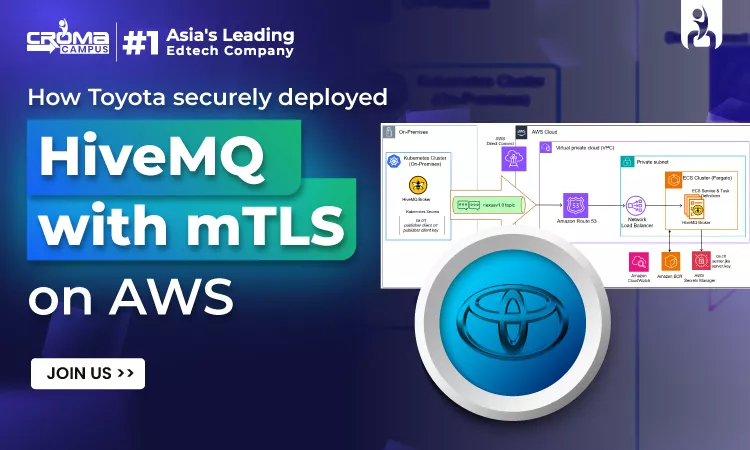
- How the AWS setup works from the plant floor to the cloud, step by step
- How certificates are managed safely using AWS Secrets Manager at container startup
- Key lessons any team can use, whether you are building IIoT systems or not
Introduction
A modern Toyota plant is full of moving parts: welding arms, conveyor belts, assembly robots, guided vehicles. Every one of them produces data. Temperatures, error codes, speed readings, timing signals. The problem is that, for a long time, each machine or line kept that data to itself. There was no shared system. No single view. Just a pile of isolated islands of information.
If you want to spot a machine failure before it happens, or find where a production line is slowing down, you need all that data in one place. That is exactly what Toyota set out to fix. Understanding these real-world scaling challenges is a core focus for anyone enrolled in a comprehensive Cloud Computing Course.
The result is NEXUS Toyota Motor North America's IIoT platform. It ties together every piece of plant floor equipment across all North American sites into one shared data stream. Real-time signals. No more silos. One place to see what is happening everywhere, at once. But connecting thousands of factory devices to a cloud system creates a new challenge just as big as the first one: how do you keep that connection safe? That is where the engineering gets interesting, making it a perfect case study to study in an AWS online course.
The Tools Toyota Used and Why
Each piece of the NEXUS stack was picked for a clear reason, none of it is accidental. Studying these corporate architecture choices provides incredible context if you are currently preparing for an AWS Online Course.
- MQTT Protocol: A lightweight messaging system made for slow or patchy networks. Factory floors fit that description perfectly. Devices publish data to topics, subscribers pick it up through a central broker.
- HiveMQ Enterprise: An enterprise-grade MQTT broker, designed for large and industrial scenarios. Capable of supporting millions of simultaneous connections, providing clustering reliability, and extensions like custom add-ons for auth and data routing.
- Amazon ECS Fargate: Serverless containers on AWS. As Toyota, we are running HiveMQ here without any server management. ECS manages the lifecycle of starting, stopping containers and replacements in case one fails.
- Mutual TLS (mTLS): The process of authenticating both ends of a connection-a device and a server-with the use of a digital certificate. Without a valid certificate, the connection is not established.
- AWS Secrets Manager: A safe place to store passwords and certificates. Containers fetch them at startup, so sensitive files never end up inside a Docker image or a config file on disk.
How Does Data Move from the Factory Floor to the Cloud?
The path a data point takes from a sensor on a welding robot to a cloud dashboard passes through six clear stages. Each one has a job to do. Learning to map out these deep, multi-stage hybrid architectures is exactly what students master when training at an AWS Training in Noida.

How NEXUS connects
Plant Equipment to the Local Edge Broker
Each machine on the factory floor sends its data via MQTT to a local broker on the plant's network. This broker collects everything from that site and prepares it to send to the cloud. It holds its own security certificate, which it uses to prove its identity when connecting outbound.
AWS Direct Connect Off the Public Internet
Data travels to AWS over a private, dedicated link rather than the open internet. This removes a large portion of the attack surface and keeps connection quality steady and reliable.
Amazon Route 53: Finding the Right Address
Every device connecting to the cloud uses a hostname to find the broker. Route 53 turns that name into the right IP address. This makes it easy to change where traffic goes without touching any device config.
Network Load Balancer Passing Traffic Through, Not Inspecting It
The load balancer works at the raw network level and sends traffic straight to HiveMQ without opening or reading the encrypted connection. This is called TLS pass-through, and it is essential. If the load balancer breaks open the connection, the mutual authentication process breaks too.
Amazon ECS Fargate Where HiveMQ Lives
HiveMQ runs as containers in private AWS subnets. ECS keeps the right number of containers running at all times. If one crashes, it is replaced automatically, and the load balancer is updated right away. No one needs to step in.
Downstream Subscribers Receive the Data
Analytics tools, maintenance systems, and live dashboards subscribe to MQTT topics and receive the data they need. Each subscriber also needs a valid certificate to connect, no exceptions.

Diagram 2: Step-by-step message flow
Why Is Mutual TLS Safer Than a Password?
In a normal secure connection (regular TLS), only the server proves who it is. The browser or app just checks that the website is real, then connects. That works fine for a shopping site. But in an industrial network where hundreds of devices are sending live data, you need to know that every single device is who it says it is, not just the server. This high-level authentication strategy maps directly to the advanced security domains found in the AWS Certified Solutions Architect Course.
That is what mutual TLS (mTLS) does. Both sides of the connection show a digital certificate. If either side cannot produce a valid one, the connection is shut down before a single byte of data is shared.
How does the mTLS Handshake work?
Step 1: The plant floor broker connects and sends its certificate to HiveMQ.
Step 2: HiveMQ checks whether this certificate is signed by our trusted authority. If not, connection refused.
Step 3: HiveMQ sends back its own certificate so the broker can verify it too.
Step 4: Both sides are verified. The encrypted session starts, and MQTT data begins to flow.
If either check fails, the connection drops immediately. No data is shared. No error message that could be used to probe the system.
The one line in HiveMQ's config that makes this happen is With that set, a device without a certificate cannot connect. It does not matter what username or password it tries.
Where do the Certificates Come From?
Every certificate in the NEXUS system is signed by the same Certificate Authority (CA), a root of trust that both HiveMQ and all connected devices share. Toyota used a self-signed CA for the pilot phase. For full production use, AWS Private CA is a better fit because it handles certificate rotation and expiry on its own. Managing these heavy automation patterns is a staple topic taught within the AWS DevOps Course.
| Certificate | What It Does | Where It Stays |
| server.jks | HiveMQ's own identity proves the broker is real | AWS Secrets Manager, loaded at startup |
| ca.jks | The truststore is used to check all incoming certificates | AWS Secrets Manager, loaded at startup |
| publisher client cert | Proves the plant-floor broker is allowed to connect | On-premises Kubernetes cluster |
| subscriber client cert | Proves that a downstream app is allowed to receive data | Each subscriber application environment |
Running HiveMQ Safely on ECS Fargate
Getting HiveMQ onto ECS is one thing. Making it production-safe is another. Toyota made design choices that ensure data flows seamlessly to backend analytics engines. Which often feed predictive maintenance algorithms, a workflow heavily analysed in the AWS Certified AI Practitioner Course.

ECS cluster layout
Certificates Are Never Stored Inside the Container Image
Putting a certificate inside a Docker image is a common mistake. If the image is ever accessed by the wrong person, all your secrets are exposed. Instead, the ECS container fetches everything it needs from AWS Secrets Manager each time it starts up. Here is a simplified version of how that startup command works:
The result is that no sensitive file ever touches the Docker image, the task definition, or any log. If a certificate needs to be changed, you update it in Secrets Manager. The next container that starts automatically picks up the new version. This decoupling strategy is highly recommended in any modern Amazon Web Services Certification Training.

ECS task configuration
One Custom Image, Consistent Everywhere
Toyota built a single HiveMQ Docker image with all the needed add-ons already included, then stored it in Amazon ECR. Every container that runs anywhere in the cluster is an exact copy of that image. There are no differences between instances, no drift, no surprises.
The System Fixes Itself When Something Goes Wrong
The ECS service is set to keep a certain number of HiveMQ containers running at all times. The load balancer checks port 8883 on each container on a regular basis. If a container stops responding, ECS replaces it and tells the load balancer about the new one. Existing connections are drained gracefully devices do not get cut off mid-session. For a factory that runs around the clock, this kind of self-repair is not optional.
Six Things to Take Away from This Architecture
Whether you are building an IIoT system or just thinking about cloud security in general, the lessons from NEXUS translate well beyond Toyota's factory walls.
01. Use certificates instead of passwords for device auth
A certificate check happens before any data is sent. A stolen password can be reused. A stolen certificate is still checked against a trusted authority and can be revoked without changing anything else.
02. Let the broker handle TLS, keep the load balancer out of it
If your load balancer opens the encrypted connection, mutual TLS stops working because the broker never gets to see the client's certificate. Layer 4 pass-through is not a workaround; it is required by design.
03. Never put sensitive files inside a Docker image
Images get copied, stored, and sometimes leaked. Fetch certificates at container startup from a secrets service instead. That way, you can also rotate them without rebuilding anything.
04. Design your infrastructure to recover on its own
ECS health checks plus a sensible drain period mean a failed container is replaced without anyone noticing. Build this in from the start, retrofitting self-healing into a live system is much harder.
05. Plan for certificate expiry before it becomes a crisis
A self-signed CA is fine for testing. Once you go live at scale, you need a system that tracks and renews certificates automatically. AWS Private CA does this well and saves a lot of last-minute scrambling.
06. Start small, but build as if you will grow big
NEXUS started as a pilot at one plant. Because the team designed it to scale from the beginning, rolling it out to every North American facility required no fundamental redesign, just more of the same.
You May Also Read:
EC2 Costs Using Kiro AI
Conclusion
Toyota's NEXUS platform shows what is possible when security and scale are treated as requirements from day one, not things to patch in later. By using MQTT as a lightweight data layer, HiveMQ as a proven broker, and AWS tools like ECS Fargate, Secrets Manager, and a carefully configured load balancer, the team built a messaging system that now serves an entire continent of manufacturing sites.
The most important part is not any single tool or service. It is the thinking behind the choices: keep secrets out of images, let the broker do its job end-to-end, make the infrastructure fix itself, and use certificates rather than passwords wherever devices are involved.
Smart manufacturing does not just mean more automation. It means more connection, more data, and if done right, much better visibility into what is really happening on the factory floor. NEXUS is a solid blueprint for any team trying to get there.
Subscribe For Free Demo
Free Demo for Corporate & Online Trainings.
Course Features
 Reals Life Practical & Case Studies
 Assignments
 Lifetime Access
 Expert Support
 Global Certification
 Job Portal Access
RELATED BLOGS
How Do You Authenticate To AWS CLI Using Aws Login Without IAM Access Keys?
How To Build An AI Film Crew On AWS: A Complete Guide
Interconnected Kitchen: Link Azure And AWS With A VPN
How Does AWS Control Tower Simplify Multi-Account Cloud Governance?
How To Set Up An AWS Account: Step-by-Step Beginner Guide
Quick Reference Guide For AWS Certified AI Practitioner
How Toyota Securely Deployed HiveMQ With MTLS On AWS To Power Smart Manufac..
Major Announcements Of The What’s Next With AWS 2026
What Is Amazon Redshift?
Integrating AWS Kiro CLI Into Guidewire IntelliJ Via ACP
How To Build An IRT-Powered AI Study Coach Using Amazon Nova
-How-Do-AI-Assistants-Access-Real-Time-AWS-Knowledge-Thumb_88279844.webp)
 +91-828 706 0032
 +1 (782) 819-0044






 Interested in Course?




.webp)
.webp)

.png)


