
What Is A Cloud NAT Gateway? Architecture, Working, And Key Benefits
4.9 out of 5 based on 17456 votesLast updated on 13th Oct 2026 27.9K Views

- Bookmark

Google Cloud Cloud NAT is a distributed, software-defined service. It provides NAT for outbound traffic from supported resources such as Compute Engine.
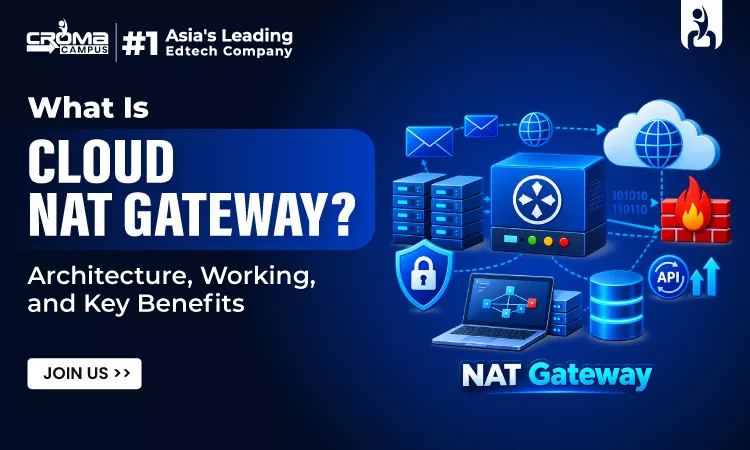
Cloud NAT is not simply a way of providing internet connectivity to private machines. Instead, Cloud NAT is a source NAT service that modifies the source IP and source port of outgoing traffic while maintaining the workload without any public IP. The knowledge of this mapping is crucial in a Cloud Computing Course because the issues related to NAT could include port exhaustion, blocked responses, incorrect egress IPs, or connection failures.
What Is a Cloud NAT Gateway?
Google Cloud Cloud NAT is a distributed, software-defined service. It provides NAT for outbound traffic from supported resources such as Compute Engine VMs, GKE clusters, Cloud Run, Cloud Run functions, App Engine standard, and regional internet NEGs, depending on the NAT type and setup. A Cloud NAT gateway is configured in a region and serves the subnets selected in its configuration.
Cloud NAT is not a proxy VM. Google Cloud applies NAT inside its software-defined networking system, while Cloud Router holds the NAT control-plane configuration.
Cloud NAT Architecture
A basic path is: Private VM → VPC subnet → routing → Cloud NAT → Internet.
A VM can have an internal address such as 10.10.1.20 and no external IPv4 address. When it opens an outbound TCP connection, Cloud NAT can translate the internal source address and source port into a public NAT IP and source port.
For example:
10.10.1.20:42000 → 142.250.x.x:443
can become:
34.x.x.x:31050 → 142.250.x.x:443
Applications should not depend on one fixed NAT port mapping because NAT IP and port mappings can change based on usage.
A second useful topic for a Cloud Computing Course is how this state is kept for return traffic.
Cloud NAT also handles return traffic for established connections. It does not act as a general inbound gateway for unsolicited connections. A server on the internet cannot normally start a fresh connection to a private VM simply because that VM uses Cloud NAT.
Related Courses:
How Cloud NAT Works?
The packet process is:
- A private resource starts an outbound connection.
- VPC routing sends the packet toward the destination.
- Cloud NAT selects a NAT IP and source port.
- SNAT changes the source address and port.
- The destination sends a response.
- Cloud NAT maps it back to the private resource.
NAT is not only about IP addresses. Source ports are also limited resources. Every TCP or UDP connection needs a usable source IP and port combination.
The Port Problem Most Basic Blogs Miss
One Cloud NAT IP provides 64,512 TCP and 64,512 UDP source ports. Ports 0 through 1,023 are not used for this purpose, so large fleets can face port pressure while CPU and bandwidth look normal.
Port allocation matters in a Cloud Computing Certification Course because many VMs can share one NAT IP but still need usable source mappings. If tuples become tight, new connections can fail.
Public NAT uses static port allocation by default. Private NAT uses dynamic port allocation by default. Static allocation gives each VM a fixed amount of ports. Dynamic allocation can increase the assigned amount when a VM needs more, up to its configured limit.
Public NAT and Private NAT
Cloud NAT has two main modes.
| Area | Public NAT | Private NAT |
| Main use | Private resources reaching public IPv4 destinations | Private-to-private translation |
| NAT address | Regional external IPs | Private NAT subnet addresses |
| Common path | Internet egress | VPC, on-premises, or other cloud paths |
| Default port model | Static | Dynamic |
| EIM | Supported with limits | Not supported |
| Main concern | Public egress IP and port capacity | Address overlap and routing |
Public NAT gives internet access without an external VM IP. Private NAT handles supported private network paths and can help with overlapping private ranges.
One gateway is either Public NAT or Private NAT. If both are required for the same subnet, separate gateways can be used.
Endpoint-Independent Mapping
Endpoint-independent mapping, or EIM, is a less visible NAT feature. When enabled for Public NAT, a given internal source IP and port can keep the same NAT IP and NAT port across different destinations.
EIM can help applications that need consistent source mapping, but its mapping rules can also cause connection conflicts.
EIM also has configuration limits. It cannot be combined with dynamic port allocation or NAT rules. So it should be selected because of an application need, not simply because it sounds more advanced.
Why NAT IP Capacity Matters?
NAT IPs are part of the capacity model. Adding another NAT IP adds another pool of source ports. With manual Public NAT IP assignment, you can keep a known group of public addresses for outbound traffic.
Automatic NAT IP allocation can add regional external IPs based on demand and configuration. Manual allocation gives more control, but the pool must be large enough. If available source IP and port tuples are exhausted, new packets can be dropped.
Cloud NAT Is Not a Firewall
NAT changes addresses and ports. Firewall rules decide whether traffic is allowed.
A private VM can use Public NAT for outbound access while still being controlled by VPC firewall policy. Cloud NAT does not make a workload automatically secure. A design still needs firewall rules, identity controls, application security, and monitoring.
For a Cloud Computing Course in Pune, this difference can be tested by allowing egress, blocking a destination, and then checking the NAT result. The lab makes the clear difference between translation and access control.
Logging and Troubleshooting
In case of any failure in NAT traffic, just checking the VM will not help. Analyze the gateway, subnet coverage, NAT IP capacity, port capacity, routes, firewall rules, and behavior of the destination.
The Cloud Computing Course in Hyderabad can use a private VM lab to create HTTPS traffic and analyze NAT logs, which will explain the difference between connectivity, translation, and monitoring.
A useful approach for troubleshooting is as follows:
- Check route and subnet being served.
- Check NAT IP and port capacity.
- Check firewall rules.
- Check NAT logs and monitoring.
- Check destination rejection and connection drop rate.
The Cloud NAT provides NAT logs for connection tracing and traffic analysis. Cloud Monitoring provides NAT metrics for observing gateway usage.
You May Also Read:
Cloud Computing Interview Questions And Answers
Top Cloud Platform Service Providers
How To Get Into Cloud Computing
Build A Cloud-Native Application
NAT in GKE and Serverless Workloads
Cloud NAT is also important when the workload is not a simple VM. GKE nodes and supported serverless workloads can use Cloud NAT through the required VPC connectivity design. Many pods or instances can create outbound connections through a smaller set of egress paths.
Connection count can matter more than node count. A service can create thousands of outbound connections and cause NAT pressure while CPU and memory look healthy.
Learners in a Cloud Computing Course in Chennai should test connection-heavy workloads. Measure concurrent connections, reuse, retries, and NAT port usage.
A Less Obvious Design Issue: Connection Reuse
NAT capacity depends on how an application creates connections, not only on how many requests it sends.
HTTP keep-alive, connection pooling, gRPC reuse, and long-lived TCP sessions can reduce the number of new source-port mappings. An application that creates a new TCP connection for every small request can create much more NAT churn.
A Cloud Computing Certification Course should cover this link because cloud networking failures can begin with the application's connection model.
Practical Design Checks
Before deploying Cloud NAT on a massive production environment, ensure the following:
- Which subnets require NAT?
- Whether destination IP addresses are public or private?
- How many VMs, nodes, or serverless VMs can be there at maximum scale?
- Number of TCP & UDP connections that each workload can make?
- Are the public egress IP addresses allowed listed?
- Will static or dynamic port allocation work?
- Are the NAT IP addresses automatic or manual?
- Is logging configured for traffic that needs investigation?
- Have firewall and route rules been independently tested?
- Does autoscaling have the potential to spike NAT requirements all of a sudden?
The above checklist could form part of the network lab for Cloud Computing Coaching in Bangalore as learners will get an opportunity to calculate port and connection requirements before making the gateway. This helps in better capacity planning as engineers can correlate application behavior with network constraints before things fail in production.
Key Takeaways
- Cloud NAT offers outbound address translation services without using proxy virtual machines.
- Public NAT enables controlled internet egress for the private resources.
- Private NAT manages supported private-to-private address translations.
- NAT scalability is based on IP addresses and source ports.
- Static and dynamic IP assignments serve different traffic types.
- EIM alters source mapping functionality and has restrictions.
- NAT cannot substitute firewall policies and applications’ protection.
- Logs and Cloud Monitoring can be used to detect connection issues.
- Connection re-use can help avoid unnecessary port translations.
- Autoscaling should be taken into consideration while planning NAT scalability.
Conclusion
Cloud NAT looks simple, but production use depends on several technical details. The main job is source translation, but good design also needs NAT IP capacity, source-port planning, mapping behavior, subnet scope, firewall rules, connection reuse, and monitoring. Public NAT and Private NAT solve different network problems, so the mode must match the traffic path. A strong cloud design does not stop at asking whether a private VM can reach the internet. It also asks how many connections the system can support, which source IPs will appear, what happens during autoscaling, and how a failed connection will be traced.
FAQs
Is there an allocation of a public IP to the VM in Cloud NAT?
No, the VM continues to have a private IP address, and NAT uses the NAT IP with the source port in order to translate the traffic.
Does the Internet establish a connection to a VM using Cloud NAT?
No, it works only to support return traffic for established connections.
How can NAT fail despite adequate bandwidth in the VM?
Even though CPU, memory, and bandwidth are adequate, NAT can fail because it runs out of source IP and port pair.
What is the difference between Public NAT and Private NAT?
Public NAT handles public IPv4 destinations, whereas Private NAT handles private network destination.
How is connection reuse essential to NAT?
Connection pooling and long-lived connections make less need for new source port mappings. New connections for small requests increase NAT burden.
Subscribe For Free Demo
Free Demo for Corporate & Online Trainings.
Course Features
 Reals Life Practical & Case Studies
 Assignments
 Lifetime Access
 Expert Support
 Global Certification
 Job Portal Access
RELATED BLOGS
What Is A Cloud NAT Gateway? Architecture, Working, And Key Benefits

What Role Do Metrics, Logs, Traces & Alerts Play In Cloud Observability?
What Is Cloud Encryption? A Complete Guide To Cloud Data Protection!
How To Build A Cloud-Native Application?

How To Get Into Cloud Computing: 7 Steps To Success

How AWS Transformed IT By Making Cloud Computing Accessible To Everyone?

Which Are The Top Cloud Computing Trends To Watch Out For In 2026?
How To Download And Use AWS Kiro IDE: A Complete Guide

How Cloud Computing Is Powering The Future Of AI & ML?

What Is Cloud Computing? Everything You Need To Know

Cloud Computing Interview Questions And Answers

 +91-828 706 0032
 +1 (782) 819-0044






 Interested in Course?




.webp)
.webp)

.png)


