
SP3D Vs Traditional Design Tools: Why Does It Matters?
4.9 out of 5 based on 15455 votesLast updated on 22nd May 2026 28.5K Views

- Bookmark

Compare SP3D and traditional design tools to understand how modern 3D engineering software improves accuracy, collaboration, productivity, and project efficiency in industrial design.
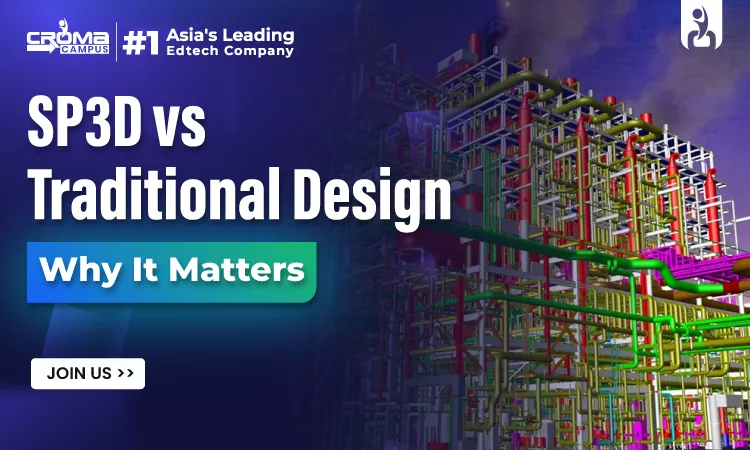
Plant design work is not like before anymore. Earlier, most engineers worked on drawings only. The main job was making layouts, checking dimensions, and preparing design sheets. But now industries want more than just drawings. They want better coordination, faster work, fewer mistakes, and proper engineering data connected with the design. This is one reason why SP3D Training is becoming important in plant engineering and industrial design work.
Traditional design tools still exist in many companies. They are useful for drafting work. But big industries now work on very large projects where thousands of components are connected together. In such projects, simple drafting software creates many problems. SP3D works differently. It is not only for drawing. It works like a complete engineering system where design data, piping information, structure details, and equipment connections all stay linked together.
That is the main difference.
What Traditional Design Tools Actually Do?
Traditional design software mainly helps engineers create drawings. The software understands shapes and lines, but it does not fully understand engineering logic.
For example:
- A pipe is just shown as a line
- A valve looks like a symbol
- Equipment is placed like a block
- Structures are treated like objects only for viewing
The software does not know how everything is connected technically. Because of this, engineers spend a lot of time doing manual checking.
They check:
- Pipe routing
- Dimensions
- Layout clashes
- Material quantities
- Drawing revisions
- Equipment positions
This process becomes difficult when projects become bigger. Small projects may still work properly in traditional systems, but large industrial projects become hard to manage.
How does SP3D Work Differently?
SP3D is made for intelligent plant design. Every object inside the model contains engineering information. A pipe inside SP3D is not just a line.
It contains:
- Pipe size
- Material type
- Pressure class
- Connection details
- Routing information
- Engineering specifications
The same happens with valves, supports, nozzles, and equipment. The software understands the relationship between components. That helps engineers work faster and with better accuracy.
Many industries now prefer engineers who understand Sp3d Admin Training because project setup and database handling are very important in SP3D projects.
Why Old Systems Create Problems
Traditional systems mostly depend on people checking everything manually.
This creates many common issues:
- Wrong revisions
- Design mismatch
- Late clash detection
- Material errors
- Slow coordination
- Rework during construction
When one department changes something, other teams may not get updated immediately. For example, piping may change, but structural teams may continue working on older layouts. Later, clashes appear during fabrication or installation. This wastes time and money.
Why is SP3D Better for Large Projects?
Large industrial plants are very complicated.
They contain:
- Thousands of pipes
- Heavy structures
- Large equipment
- Electrical systems
- Instrumentation lines
- Support systems
Managing all this manually becomes difficult. SP3D helps because all project data stays connected in one system. Different teams can work together inside the same project environment.
This improves:
- Coordination
- Revision handling
- Design accuracy
- Communication
- Engineering speed
That is why many EPC companies now use SP3D for large projects.
Database System Makes a Huge Difference
One big difference between SP3D and traditional software is database handling. Traditional tools store work in separate drawing files. SP3D stores project information inside a connected database. This means all departments work using the same project data. If one team updates something, others can see the latest information faster.
This reduces confusion.
It also helps during:
- Drawing updates
- Quantity extraction
- Project reviews
- Material planning
- Construction coordination
The whole workflow becomes smoother.
Better Clash Detection
Clash detection is one of the strongest parts of SP3D. Traditional tools usually depend on manual checking. Engineers often find clashes very late. Sometimes problems are discovered only during site installation. SP3D checks clashes automatically inside the model.
It can detect:
- Pipe clashes
- Structural clashes
- Equipment clearance problems
- Support conflicts
- Maintenance access issues
This helps engineers fix problems early. Fixing a problem during design is much easier than fixing it on site.
Comparison Between SP3D and Traditional Design Tools Why Does Engineering Data Matters Now?
Earlier, drawings were enough for many projects. Now industries need proper engineering data also.
Companies want:
- Accurate material quantities
- Better procurement planning
- Fabrication details
- Asset information
- Maintenance records
Traditional drafting systems mainly focus on graphics. SP3D focuses on engineering information along with graphics. This gives better control over the project. That is one reason why demand for SP3D Training is growing among plant design engineers.
Better Team Coordination
Plant engineering projects involve many departments together.
These include:
- Piping
- Structural
- Civil
- Electrical
- Instrumentation
- HVAC
- Process engineering
Traditional workflows create communication gaps because teams work separately. SP3D improves coordination because everyone works inside one connected environment.
This helps during:
- Pipe routing
- Equipment placement
- Cable tray planning
- Structural support work
- Maintenance space checking
The project becomes easier to manage.
Why Revision Control is Important?
Industrial projects keep changing during execution. Design revisions happen regularly. Traditional systems make revision handling difficult because updates are manual. Sometimes teams continue working on old drawings.
This creates:
- Wrong fabrication
- Site confusion
- Material waste
- Delay in construction
SP3D handles revisions better because objects stay linked inside the project database. Changes update faster across the model. This improves project consistency.
Automation Saves a Lot of Time
Many engineering tasks are repetitive. Traditional systems require engineers to repeat the same work again and again. SP3D automates many activities.
For example:
- Material reports
- Isometric generation
- Clash checking
- Data updates
- Design validation
This reduces manual work. Engineers can focus more on technical decisions instead of repeated drafting activities.
Why is Administration Important in SP3D?
Many people think SP3D is only about 3D modeling. But backend setup is equally important.
Project administration controls:
- Catalog setup
- Specifications
- User permissions
- Database rules
- Engineering standards
Without proper setup, the project can become unstable. This is why companies also value engineers who understand Sp3d Admin Training because administration affects the entire project workflow.
Better Material Handling
Material management is a major part of industrial projects. Wrong quantities can create serious issues in procurement and fabrication. Traditional tools often require manual quantity extraction. This increases chances of mistakes. SP3D connects material information directly with the model.
This improves:
- Quantity accuracy
- Procurement planning
- Fabrication coordination
- Inventory management
Better material control helps projects run smoothly.
Why Industries are Moving Toward Smart Systems?
Industries now want faster and smarter engineering systems.
Companies focus on:
- Less rework
- Better coordination
- Faster project completion
- Lower mistakes
- Improved project tracking
Traditional drafting systems alone cannot handle all these requirements properly. That is why intelligent engineering platforms are becoming more common.
Challenges in SP3D
SP3D is powerful, but it also takes time to learn properly.
Some common challenges are:
- Complex project setup
- Learning curve
- Hardware requirements
- Database management
- Workflow understanding
Unlike normal drafting software, SP3D requires understanding of engineering logic also. But once engineers learn the workflow, project handling becomes much better.
Why Rule-Based Engineering Helps?
SP3D follows engineering rules inside the software. This improves consistency.
The system helps maintain:
- Pipe specifications
- Routing standards
- Component compatibility
- Engineering validation
Traditional tools depend more on manual checking. Manual checking increases chances of human error. SP3D reduces this risk.
Why Traditional Tools Still Exist?
Traditional software is still used because:
- Older projects continue on those systems
- Small projects may not need advanced platforms
- Many teams are comfortable with older software
- Initial cost may look lower
But industries are changing. Modern projects are becoming larger and more connected. Simple drafting systems are slowly becoming limited for complex industrial work.
You May Also Read Related Courses:
Future of Plant Design
Plant engineering is moving toward digital systems.
Future projects will depend more on:
- Smart engineering platforms
- Connected project data
- Digital plant systems
- Intelligent workflows
SP3D supports these requirements better because the software combines engineering data with the design model.
This helps during:
- Design
- Procurement
- Construction
- Maintenance
- Future plant operations
That is why many students and professionals now search for Sp3d Course Fees before entering plant design training programs.
Why Do Companies Prefer SP3D Engineers?
Companies want engineers who can work on modern project systems.
SP3D engineers help improve:
- Coordination
- Design quality
- Project tracking
- Construction planning
- Material management
Industries now expect engineers to understand more than basic drafting. Connected engineering systems are becoming normal in large industrial projects.
Key Takeaways
- SP3D is more than a drawing software.
- Traditional tools mainly focus on drafting.
- SP3D connects engineering data with the model.
- Automatic clash detection reduces site problems.
- Database systems improve coordination.
- Revision handling becomes easier.
Sum up,
The SP3D has revolutionized industrial plant project handling nowadays. The conventional drafting design software remains effective in performing simple design drawings; however, big industrial players are increasingly adopting intelligent software solutions that integrate the engineering data and project management and design into one smart solution. SP3D increases accuracy and efficiency, fosters collaborations, and simplifies complex project designs. The integrated database system also provides improved control and management of revisions, material requirements, and other engineering processes.
Subscribe For Free Demo
Free Demo for Corporate & Online Trainings.
Course Features
 Reals Life Practical & Case Studies
 Assignments
 Lifetime Access
 Expert Support
 Global Certification
 Job Portal Access
RELATED BLOGS
What’s New In CAESAR II 14.0? Key Features And Updates Explained!
.webp)
How Can Primavera P6 Improve Resource Leveling In Construction Projects?
How CAESAR II Is Compatible With CADWorx: A Complete Integration Guide

What’s New In CAESAR II 15? Key Updates For Engineers
SP3D Vs Traditional Design Tools: Why Does It Matters?

Primavera P6 Interview Questions and Answers

E3D Interview Questions And Answers 2026

Explanation Of The Encryption And Decryption Processes

Caesar II Installation Guide Step By Step
.webp)
How To Assign Resources To Activities In Primavera P6?

What Do The Piping Designers Do?

 +91-828 706 0032
 +1 (782) 819-0044






 Interested in Course?




.webp)
.webp)

.png)


