








whatsapppopupnewiconGUIDE ME

Master Salesforce DevOps with practical training in CI/CD, automation, deployment, release management, and real-world projects.

4.5 out of 5 based on 27642 votes
google4.2/5
Sulekha4.8/5
Urbonpro4.6/5
Just Dial4.3/5
Fb4.5/5

In collaboration with

400+

Corp. Tie-Ups

Online/Offline

Format

LMS

Life Time Access

Book A Free Counselling Session

we train you to get hired.

bag-box-form
Request more information_

  • There have been rapid changes taking place within Salesforce projects. There are developers and administrators that work simultaneously on many different changes, custom objects, flows, Apex classes, integrations, and more. When such changes are performed manually, there might be some errors and confusion regarding what is done by whom and that is when Salesforce DevOps comes into play.
  • Salesforce DevOps is the process of managing Salesforce Training activities from creation to testing to deployment and release. This is done using source control, development environment, testing, automation, and deployment approach.
  • Salesforce DevOps Course will be all about the ways developers manage Salesforce changes in practice. You will learn about Git, branching, Salesforce DX, Salesforce CLI, DevOps center, deployment, testing, release pipelines, and the most common issues of deployment.
  • The main motivation for taking a Salesforce DevOps course is that Salesforce development not only means working on Apex and Salesforce configurations but also requires people who know how the changes are transferred from development to testing and finally to production.
  • By 2026 -2027, Salesforce development teams will use the new-generation DevOps Center, source control, Salesforce CLI, and much better structured release processes. According to Salesforce, the new-generation DevOps Center uses source control as a primary location of changes in projects and pipeline-based transferring between environments.
  • This is very helpful for freshers, Salesforce developers, Salesforce administrators, consultants, and IT professionals interested in knowing about the DevOps of Salesforce.
  • By learning the Salesforce DevOps, one will be able to collaborate with developers, manage deployments, learn about source control and help with Salesforce releases.

Salesforce DevOps Course

About-Us-Course

  • In this Salesforce DevOps Training, learners will study:
    • Salesforce DevOps basics

      Salesforce development lifecycle

      Git and source control

      Salesforce DX project structure

      Salesforce CLI and sf commands

      Branches and repositories

      Salesforce DevOps Center

      Development and testing environments

      Metadata management

      Change tracking

      Deployment and validation

      Apex testing

      Automated testing basics

      Release pipelines

      Pull requests and code review

      Deployment errors and troubleshooting

      Rollback and recovery concepts

      CI/CD concepts for Salesforce

      Real project release scenarios

  • The Salesforce DevOps Online Training focuses on practical work so learners can understand how Salesforce changes are managed in actual projects.

  • There are no strict requirements for joining the Salesforce DevOps Course.
    • Basic Salesforce knowledge

      Basic understanding of CRM

      Basic knowledge of software development

      Basic understanding of Git

      Basic idea about Apex is useful

      Interest in cloud and development tools

  • Freshers can also start with this Salesforce DevOps Course. Basic Salesforce knowledge will make the learning easier, but you do not need to be an expert.

  • The following candidates can join the Salesforce DevOps Training:
    • Fresh graduates

      Salesforce developers

      Salesforce administrators

      Salesforce consultants

      Salesforce technical consultants

      Apex developers

      Release engineers

      DevOps professionals

      Software developers

      QA professionals

      IT professionals

      Working Salesforce professionals

  • The Salesforce DevOps Course can help both beginners and experienced Salesforce professionals who want to learn the deployment and release side of Salesforce.

  • Salesforce DevOps Basics
    • Understanding Salesforce DevOps

      Understanding the Salesforce development lifecycle

      Learning about development environments

      Understanding deployment stages

      Managing Salesforce project changes

  • Source Control
    • Understanding Git

      Creating repositories

      Working with branches

      Making commits

      Creating pull requests

      Reviewing code changes

      Handling merge conflicts

  • Salesforce DevOps Center uses source control as a main source for project changes, and it can connect with supported providers such as GitHub and Bitbucket.
  • Salesforce DX
    • Understanding Salesforce DX

      Creating Salesforce DX projects

      Understanding project folders

      Working with metadata

      Understanding sfdx-project.json

      Managing source format

  • Salesforce CLI
    • Installing Salesforce CLI

      Authorizing Salesforce orgs

      Retrieving metadata

      Deploying metadata

      Running tests

      Checking deployment status

  • Salesforce CLI provides command-line access to Salesforce DX features and is used for development and deployment work.
  • DevOps Center
    • Understanding DevOps Center

      Creating projects

      Connecting source control

      Creating pipeline stages

      Managing work items

      Promoting changes

      Tracking changes

      Managing release activities

  • The next-generation DevOps Center uses projects, work items, source control, environments, and pipeline stages to manage Salesforce changes.
  • Deployment and Testing
    • Metadata deployment

      Deployment validation

      Apex testing

      Deployment checks

      Test results

      Deployment errors

      Fixing failed deployments

      Post-deployment checks

  • CI/CD and Automation
    • Understanding CI/CD

      Automated deployment concepts

      Build and test process

      Release pipelines

      Automated checks

      Source control based deployment

      Deployment automation

  • Monitoring and Troubleshooting
    • Checking deployment errors

      Reading error messages

      Finding failed components

      Checking test failures

      Resolving metadata issues

      Handling merge conflicts

      Checking API version problems

  • Real Project Scenarios
    • Salesforce development workflow

      Developer to testing deployment

      Testing to production release

      Git-based Salesforce project

      DevOps Center pipeline

      Failed deployment troubleshooting

      End-to-end release process

  • The tools covered in the Salesforce DevOps Online Course are:
  • Salesforce DevOps Center
    • Project management

      Work items

      Release pipelines

      Change tracking

      Environment management

  • The next-generation DevOps Center is the current direction for Salesforce release management in 2026. Salesforce stopped new downloads and installations of the older managed package from April 2026 and recommends the next-generation version.
  • Git and GitHub
    • Repository management

      Branch creation

      Commits

      Pull requests

      Code review

      Version history

  • Following are some of the roles that professionals can take up after completing Salesforce DevOps Engineer Course
  • Salesforce DevOps Engineer
    • Manage Salesforce deployments

      Maintain release pipelines

      Work with source control

      Support CI/CD processes

  • Salesforce Release Engineer
    • Plan Salesforce releases

      Manage deployment activities

      Check release readiness

      Support production releases

  • Salesforce DevOps Consultant
    • Plan DevOps processes

      Guide Salesforce teams

      Set up deployment workflows

      Improve release processes

  • Salesforce Developer
    • Develop Apex and Lightning solutions

      Manage source code

      Test changes

      Deploy Salesforce components

  • Salesforce Technical Consultant
    • Understand project requirements

      Support Salesforce development

      Manage technical changes

      Help with integration and deployment work

  • Salesforce DevOps professionals can get good career opportunities because companies need people who can manage both Salesforce development and release work.
  • Salesforce DevOps Freshers (0-2 Years of Experience)
    • Average salary: 4 LPA - 8 LPA

      Work as Junior Salesforce Developer

      Support deployment activities

      Handle testing and basic DevOps tasks

  • Salesforce DevOps Mid-Level Professionals (3-6 Years of Experience)
    • Average salary: 8 LPA - 18 LPA

      Manage Salesforce releases

      Work with Git and deployment pipelines

      Handle development and testing environments

  • Salesforce DevOps Experienced Professionals (7+ Years of Experience)
    • Average salary: 18 LPA - 35+ LPA

      Lead Salesforce DevOps projects

      Design release processes

      Manage production deployments

      Guide development teams

  • Salary can change based on skills, company, location, Salesforce experience, and project role.

  • Professionals with Salesforce DevOps skills can work in many industries.
  • Information Technology
    • Salesforce application development

      Cloud projects

      DevOps automation

  • Banking and Finance
    • CRM development

      Secure application releases

      Customer data systems

  • Retail
    • Salesforce Commerce projects

      Customer applications

      CRM integrations

  • Healthcare
    • Customer and patient service systems

      Salesforce applications

      Data integration

  • Manufacturing
    • CRM solutions

      Business process automation

      Salesforce integrations

  • Telecom
    • Customer management

      Application development

      System integration

  • Consulting
    • Salesforce implementation

      DevOps projects

      Cloud transformation

  • Module 1: Introduction to Salesforce DevOps
    • Salesforce DevOps overview

      Development lifecycle

      DevOps benefits

      Salesforce project workflow

  • Module 2: Git and Source Control
    • Git basics

      Repositories

      Branches

      Commits

      Pull requests

      Merge conflicts

  • Module 3: Salesforce DX
    • Salesforce DX overview

      Project creation

      Source format

      Metadata

      Project structure

  • Module 4: Salesforce CLI
    • CLI setup

      Org authorization

      Metadata retrieval

      Deployment commands

      Test commands

  • Module 5: DevOps Center
    • DevOps Center overview

      Projects

      Work items

      Source control connection

      Pipeline stages

      Change promotion

  • Module 6: Deployment and Testing
    • Metadata deployment

      Validation

      Apex testing

      Deployment errors

      Test results

  • Module 7: CI/CD and Release Management
    • CI/CD concepts

      Automated testing

      Deployment automation

      Release pipelines

      Production releases

  • Module 8: Real Project Scenarios
    • Salesforce development project

      Git workflow

      DevOps Center pipeline

      Deployment troubleshooting

      End-to-end Salesforce release

  • The demand for Salesforce DevOps Online Course is growing as Salesforce teams need better ways to manage development, testing, source control, and production releases.
  • After learning Salesforce DevOps, you can:
    • Learn how Salesforce development teams work.

      Manage Salesforce changes using source control.

      I work with Git and Salesforce CLI.

      Understand DevOps Center and release pipelines.

      Learn deployment and testing methods.

      Handle common Salesforce deployment problems.

      I work as a Salesforce DevOps Engineer.

      Move towards Salesforce development and release management roles.

  • Salesforce also supports moving both metadata and certain configuration data through DevOps Center workflows, making data and metadata handling an important part of modern Salesforce release work.

Why Should You Learn Salesforce DevOps?

Not just learning

we train you to get hired.

bag-box-form
Request more information

By registering here, I agree to Croma Campus Terms & Conditions and Privacy Policy

CURRICULUM & PROJECTS

Salesforce DevOps Engineering Training Program

    DevOps culture and CALMS principles

    Salesforce application lifecycle and release challenges

    Development - integration - testing - release lifecycle

    Org-based vs source-driven development

    Continuous Integration, Continuous Delivery and Continuous Deployment

    Roles: developer, DevOps engineer, release manager and architect

    DevOps maturity model for Salesforce teams

Get full course syllabus in your inbox

    Salesforce metadata and component types

    Apex, Lightning Web Components and declarative automation

    Objects, fields, permission sets and profiles

    Flows, validation rules and custom metadata

    Deployment dependencies

    Apex testing fundamentals

    Understanding metadata coverage and deployment limitations

Get full course syllabus in your inbox

    Salesforce DX architecture and benefits

    Salesforce CLI installation and configuration

    Authentication using org login and authorization methods

    Source format vs metadata format

    Project structure and sfdx-project configuration

    Scratch org creation and configuration

    Org aliases, commands and automation

    CLI-based deployment, retrieval and validation

Get full course syllabus in your inbox

    Git fundamentals for Salesforce teams

    Repositories, commits, branches and tags

    Branching strategies: Git Flow, trunk-based and feature branching

    Pull requests and code review

    Merge conflicts and resolution

    Git hooks and commit standards

    Release tags and versioning

    Repository structure and governance

Get full course syllabus in your inbox

    Developer sandbox and scratch org strategies

    Feature development workflow

    Source tracking and synchronization

    Org-dependent development

    Metadata retrieval and deployment

    Dependency management

    Code review workflow

    Developer-to-integration-org promotion process

Get full course syllabus in your inbox

    Apex unit testing and test data strategies

    Deployment test levels and test execution

    Static code analysis with Salesforce Code Analyzer

    PMD and quality-rule concepts

    Code coverage and quality thresholds

    Linting and formatting

    Security and dependency checks

    Automated quality gates and failed-build handling

Get full course syllabus in your inbox

    Metadata deployment and validation strategies

    Change sets vs source-driven deployments

    Deployments using Salesforce CLI and APIs

    Package-based deployment concepts

    Unlocked packages and version management

    Release branches and release candidates

    Production deployment planning

    Rollback and recovery strategies

    Change tracking and release documentation

Get full course syllabus in your inbox

    Security in Salesforce DevOps

    Connected apps, OAuth and authentication concepts

    Secrets and credential management

    Environment-specific configuration

    Named credentials and secure integration considerations

    Permission and access governance

    Security scanning and vulnerability management

    Auditability and compliance controls

Get full course syllabus in your inbox

    Reusable pipeline templates

    Pipeline-as-code

    Deployment orchestration

    Parallel validation and test execution concepts

    Automated data seeding strategies

    Environment provisioning

    Scratch org pools and ephemeral environments

    Custom automation with scripts

    Event-driven and API-based DevOps automation

Get full course syllabus in your inbox

    Pipeline monitoring and deployment metrics

    Deployment failure analysis

    Debug logs and Apex troubleshooting

    Release frequency and lead-time metrics

    Change failure rate and mean time to recovery

    DevOps dashboards and reporting

    Governance, documentation and operational readiness

Get full course syllabus in your inbox

    Design a Git-based Salesforce DevOps architecture

    Create repository and branching strategy

    Configure Salesforce DX project and environments

    Build CI validation and automated testing pipeline

    Implement staging and production deployment pipelines

    Add code-quality and security gates

    Implement approval and release workflow

    Prepare DevOps documentation and executive demonstration

Get full course syllabus in your inbox

+ More Lessons

Course Design By

naswipro

Nasscom & Wipro

Course Offered By

croma-orange

Croma Campus

Real

star

Stories

success

inspiration

person1

Kartik

career upgrade

person1

Tushar

career upgrade

person1

Anika

career upgrade

person1

Anamika

career upgrade

SELF ASSESSMENT

Learn, Grow & Test your skill with Online Assessment Exam to
achieve your Certification Goals

right-selfassimage
Get exclusive
access to career resources
upon completion
quote
Mock Session

You will get certificate after
completion of program

laptop
LMS Learning

You will get certificate after
completion of program

star
Career Support

You will get certificate after
completion of program

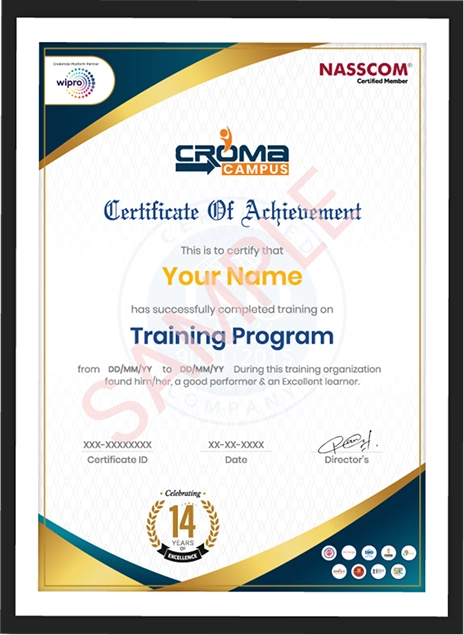
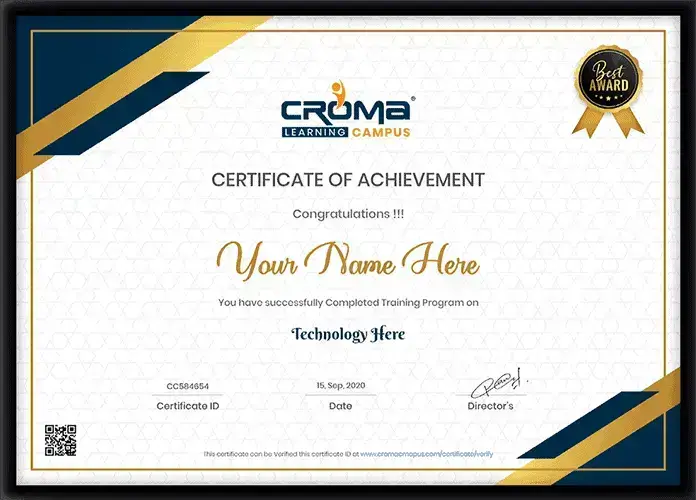
Showcase your Course Completion Certificate to Recruiters

  • checkgreenTraining Certificate is Govern By 12 Global Associations.

  • checkgreen1Training Certificate is Powered by “Wipro DICE ID”
  • checkgreen2Training Certificate is Powered by "Verifiable Skill Credentials"

in Collaboration with

dot-line
Certificate-new-file

Not Just Studying

We’re Doing Much More!

Empowering Learning Through Real Experiences and Innovation

Mock Interviews

Prepare & Practice for real-life job interviews by joining the Mock Interviews drive at Croma Campus and learn to perform with confidence with our expert team.Not sure of Interview environments? Don’t worry, our team will familiarize you and help you in giving your best shot even under heavy pressures.Our Mock Interviews are conducted by trailblazing industry-experts having years of experience and they will surely help you to improve your chances of getting hired in real.
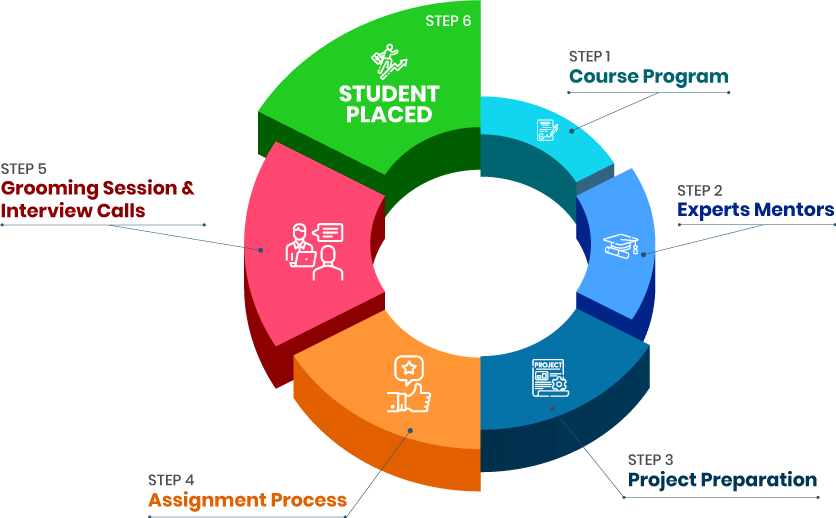
How Croma Campus Mock Interview Works?graph_new

Not just learning

we train you to get hired.

bag-box-form
Request A Call Back

Phone (For Voice Call):

‪+91-828 706 0032

WhatsApp (For Call & Chat):

+91-828 706 0032
          

Download Curriculum

Get a peek through the entire curriculum designed that ensures Placement Guidance

Course Design By

nasco wp

Course Offered By

Request Your Batch Now

Ready to streamline Your Process? Submit Your batch request today!

Students Placements & Reviews

speaker
Mohammad Sar
Mohammad Sar
speaker
Prayojakta
Prayojakta
speaker
Sanchit Nuhal
Sanchit Nuhal
speaker
Saurav Kumar
Saurav Kumar
speaker
Rupesh Kumar
Rupesh Kumar
speaker
Harikesh Panday
Harikesh Panday
View More arrowicon

FAQ's

Salesforce DevOps can be explained as an approach for Salesforce development, testing, source control, deployment, and release management.

This is the training course where you learn to manage Salesforce changes from development to production stage through DevOps approach.

Yes, they can. The only requirement is to have basic Salesforce and computer skills.

Salesforce DevOps Center is a Salesforce software tool to help manage development changes, source control, environments, and release pipelines.

It is useful to have basic Salesforce knowledge, but you don’t need to be an expert.

Git helps store, track, review and manage changes in Salesforce projects.

Salesforce CLI is a Salesforce command line tool used in development, metadata operations, testing, and deployment processes.

Salesforce DX is a way of development and a suite of tools for building, testing, managing and deploying Salesforce apps.

Salesforce DevOps Engineer manages Salesforce development process, source control, testing, deployment, and release.

CI/CD refers to having an organized and sometimes automated way to build, test, and deploy Salesforce modifications.

Sure. You can study Salesforce DevOps by doing practical online training with assignments based on projects.

Deployment is the movement of Salesforce metadata and associated modifications from one environment to another.

Sandbox is a separate Salesforce environment for developing, testing, and doing other work within a project.

Release pipeline refers to the predetermined route through which Salesforce modifications are going from development to testing, staging, and production environments.

Source control means storing project modifications in a shared repository to be able to monitor versions and collaborate with team members.

Certainly. Salesforce administrators may learn DevOps in order to understand how source control, deployment, testing, and releases are done.

Some tools that you may find are Salesforce DevOps Center, Salesforce CLI, Salesforce DX, Git, GitHub, and CI/CD tools.

Positions may be sought in the form of Salesforce DevOps Engineer, Salesforce Developer, Release Engineer, and Salesforce DevOps Consultant.

Yes. In today’s Salesforce teams, there is a need for improved source control, testing, deployment, and release, which makes DevOps relevant now.

You will get to learn Git, Salesforce DX, Salesforce CLI, DevOps Center, deployment, testing, CI/CD, release pipeline, among others.

Career Assistancecareer assistance
  • - Build an Impressive Resume
  • - Get Tips from Trainer to Clear Interviews
  • - Attend Mock-Up Interviews with Experts
  • - Get Interviews & Get Hired

Our learners
transformed their careers

highest
35 Laks

Highest Salary Offered

money
50%

Average Salary Hike

building
30K+

Placed in MNC’s

setting
15+

Year’s in Training

alumini
A majority of our alumni

fast-tracked into managerial careers.

Get inspired by their progress in the

Career Growth Report.

FOR VOICE SUPPORT

FOR WHATSAPP SUPPORT

sallerytrendicon1

Get Latest Salary Trends

×

For Voice Call

+91-971 152 6942

For Whatsapp Call & Chat

+91-9711526942
newwhatsapp
1
//