







whatsapppopupnewiconGUIDE ME

Master Manual Testing with hands-on training in test case creation, defect tracking, and QA processes to launch a successful career in software testing.

4.75 out of 5 based on 36990 votes
google4.2/5
Sulekha4.8/5
Urbonpro4.6/5
Just Dial4.3/5
Fb4.5/5

In collaboration with

25 Hrs.

Duration

Online/Offline

Format

LMS

Life Time Access

Book A Free Counselling Session

we train you to get hired.

bag-box-form
Request more information_

  • Manual testing training aims to educate beginners and experts how software is tested without the use of automation tools. Manual testing is essential to guarantee that applications are bug-free, easy to use, and meet client requirements. The training familiarizes learners with various testing concepts, defect reporting, real project workflows, and industry processes.
  • With flexible batches (weekdays, weekends, or fast-track), reasonable Manual Testing training institute charges in Chennai, and placement assistance, students can confidently join the QA industry. Offline and online training opportunities are available, providing opportunities for all those interested in IT careers.
    • Reasonable Manual Testing training institute charges in Chennai.

      No coding expertise needed.

      Practice on live projects included.

      Online and offline classes offered.

      Placement and interview preparation assistance.

Manual Testing Course in Chennai

About-Us-Course

  • Manual Testing course in Chennai focuses on providing you with hands-on experience of the whole testing lifecycle (STLC) and software development lifecycle (SDLC). You are trained to write test cases, run them, report bugs, and deliver quality. Focus is on live testing of live applications to align with industry standards. Manual testing basics that you learn enable you to lay a solid foundation which assists you with automation testing in the future. The course also makes students ISTQB certification-ready, and thus they can confidently seek jobs in QA roles for MNCs. With step-by-step guidance, the learners become job-ready QA experts.
    • Understand SDLC and STLC concepts.

      Write and run test cases successfully.

      Learn functional, regression, and acceptance testing.

      Get hands-on experience with defect reporting tools.

      Prepare for international certifications such as ISTQB.

  • The Manual Testing course in Chennai offers interactive and practical modules for guaranteed learning. Instructors are professionals from the field who use case studies to illustrate testing procedures.
    • Live hands-on projects.

      Weekly assignments and quizzes.

      Certification preparatory sessions.

      Placement-focused interview training.

      Flexible batch schedules.

  • The Chennai Manual Testing Course institute is available to all students, from all backgrounds. Fresh graduates, non-IT students, as well as working professionals, can apply.
    • Freshers in search of jobs in IT.

      Graduate degree holders from any discipline.

      QA candidates from non-technical streams.

      IT professionals transitioning to QA.

      Business analysts or product managers transitioning to QA.

  • The Manual Testing course at Chennai provides learners with extensive job opportunities in industries. Manual testers are always required to ensure applications for usability and functional coverage. Finance, healthcare, SaaS, and e-commerce companies employ testers for the provision of stable software.
    • Roles: QA Analyst, Test Engineer, Junior Tester.

      Industries: IT, banking, e-commerce, healthcare.

      Career development into performance testing and automation.

      Worldwide demand for manual testers.

      Building blocks for advanced testing positions.

  • The Manual Testing course costs in Chennai contain comprehensive topics covering theoretical and practical knowledge. Students are familiar with software development models, testing types, and actual industry workflows.
    • Introduction to Testing

      What is software testing Importance and principles.

      Errors, faults, failures explained.

      Software Development Life Cycle (SDLC)

      Waterfall, Agile, V-Model.

      Real-world applications of each.

      Software Testing Life Cycle (STLC)

      Phases: Requirement analysis, planning, execution, reporting, closure.

      Types of Testing

      Functional testing.

      Regression, sanity, smoke, integration, and UAT.

      Writing and Executing Test Cases

      How to design test scenarios.

      Mapping requirements to test cases.

      Test Design Techniques

      Equivalence partitioning.

      Boundary value analysis.

      Decision tables, state transition.

      Defect Management

      Defect cycle understanding.

      Logging bugs with severity and priority levels.

      Hands-on with JIRA and Bugzilla.

      Test Management Tools

      Overview of TestLink.

      Tracking test execution.

      Real-Time Project Testing

      Testing e-commerce, banking and healthcare apps.

      Reports and deliverables creation.

      Capstone Project

      Complete test plan, execution, bug reporting, and review.

  • The Manual Testing training in Chennai makes learners eligible for renowned QA certifications that enhance career prospects. ISTQB Foundation Level Certification and CSTE are the most sought after. These tests verify knowledge of testing fundamentals, defect handling, and processes. With a certificate, freshers and professionals get preference in interviews.

  • The fees for the Manual Testing training institution in Chennai are reasonable when compared to other IT training institutions. Course fees on average cost between 12,000 and 25,000 based on course duration, projects that are covered, and certification coaching. Flexible batch prices, installment facilities, and seasonal discounts are offered by our institute. Since students also get lifetime learning materials, interview guidance, and placement services, the benefit you derive from the Manual Testing course fees in Chennai is really greater than classroom coaching alone. Being cost-effective enables the job career of freshers to begin without financial obstacles.

  • Once Manual Testing training in Chennai is done, freshers are provided salaries ranging from 3 to 5 LPA. Healthcare, finance, and product companies might offer slightly more based on skills. Mid-level testers having 3 to 5 years of experience receive 7 to 10 LPA. Salaries exceed 12 to 15 LPA as they advance in their career into automation testing. Freelancers working for small projects of start-ups receive additional income opportunities.
    • Freshers: 3 to 5 LPA average.

      Mid-level: 7 to 10 LPA.

      Senior QA: 12 to 15 LPA.

      Freelance/manual project testing remunerates extra.

      Certifications add 20 to 30% salary increase.

  • By pursuing this course in a well-known Manual Testing training institute in Chennai, long-term career growth is assured. They begin as QA Analysts or Junior Test Engineers and become Test Leads, QA Managers, or Automation Engineers. Career streams can branch out into automation, DevOps, performance, and security testing.
    • QA Tester Senior Tester.

      Test Lead QA Manager.

      Automation or DevOps QA specialist roles.

      Long-term QA Consultant or Test Architect career.

  • The Chennai Manual Testing training is widely popular due to its accessibility for beginners, affordability, and direct job relevance. Students opt for this training to join the IT sector without coding issues. Chennai as an IT hub sees more demand, with various service companies hiring fresh QA testers. Fees for the Manual Testing course in Chennai are affordable, particularly for freshers. Employers also appreciate manual QA skills as tools cannot substitute human-initiated testing for usability or exploratory cases.
    • Affordable training fees.

      Large IT recruiter base in Chennai.

      Beginner-friendly, no coding.

      High job demand for testers.

      Practical training with certification support.

  • After completing the Manual Testing course in Chennai, learners can take on various roles across industries. Responsibilities involve writing test cases, determining test scenarios, running cases, reporting bugs, and working with developers. Testers validate applications according to specifications and deliver quality user experiences. They are also part of regression, integration, and acceptance testing cycles. Reports are submitted on a regular basis to QA leads and project managers. Manual testers are considered the last line of defense for ensuring quality delivery.
    • Software Tester.

      QA Analyst.

      User Acceptance Tester.

      Test Coordinator.

      Responsibilities:

      Writing/executing test cases.

      Bug logging & reporting.

      Regression and usability testing.

      Generating test reports and dev team coordination.

  • The Manual Testing training graduates in Chennai are placed in various industries. IT service providers recruit in bulk, finance and healthcare industries recruit testers to test compliance-intensive systems. Customer-facing applications have manual testers to depend on by e-commerce websites. Start-ups and SaaS companies recruit testers for mobile and web applications. Manual testers are still demanded since usability and business testing cannot be automated completely.
    • IT service providers.

      Banking and finance companies.

      Healthcare technology.

      E-commerce and retail.

      SaaS product companies.

      Chennai-based start-ups.

  • We are known as one of the top Manual Testing training institutes in Chennai for our low fee structure, practical projects, and assured placement. Trainers are experienced QA experts with hands-on industry experience. Our Chennai Manual Testing course fees include full training, access to resources, career guidance, and live project experience. Small batch sizes, individual doubt sessions, and career guidance ensure all students are job-ready. Corporate partners and industry connections simplify placement. Our track record of successful graduates is why companies prefer us for QA training in Chennai.
    • Trainers with experience in the industry.

      Low fees with flexible options.

      Capstone projects with actual deliverables.

      Small batches for intensive learning.

      100% placement assistance.

Why Should You Learn Manual Testing?

Not just learning

we train you to get hired.

bag-box-form
Request more information

By registering here, I agree to Croma Campus Terms & Conditions and Privacy Policy

CURRICULUM & PROJECTS

Software Manual Testing Training Program

    This course is designed for people seeking foundation level certification based on the ISTQB certification program and also interested in learning basic software testing fundamentals, manual testing concepts, database testing, mobile testing, live project training, etc. This course completely covers the current ISTQB syllabus and also provides additional information and guidance in key areas.

    Our Software testing training program is suitable for testers, test analysts, test engineers, test consultants, test managers, user acceptance testers and software developers. This Foundation Level qualification is also appropriate for anyone who wants a basic understanding of software testing, such as project managers, quality managers, software development managers, business analysts, IT directors and management consultants.

    In this program you will learn:

    • Software Testing Fundamentals
    • SDLC vs STLC
    • Software Testing Models and Methodologies
    • Testing Levels and Testing Types in Software Engineering
    • Test Cases and Test Plans in Testing
    • Project Life Cycle Management/Live Project
    • ISTQB Certification
    • Selenium Testing
    • Database Testing
    • Mobile Testing Basics
Get full course syllabus in your inbox

    Introduction

    • What is Software Testing
    • Why do we need Testing
    • How to perform the Testing
    • Benefits of Testing

    Software Testing Terminologies

    • Mistakes, Faults, Bugs & Failures
    • Priority & Severity
    • Debugging & Root Cause Analysis
    • Verification & Validation
    • Test Bed/Environment
    • Mock-ups
    • Test Scenario

    Quality Assurance & Quality Control

    • What is Quality Assurance
    • What is Quality Control
    • Quality Assurance vs Quality Control

    Software Testing as a Career

    • Best testing practices used in Software Industry
    • Software Tester Roles
    • Job Responsibilities of a Software Tester
    • Why choose Software Testing as a career
    • How training can help you to become a Software Tester
Get full course syllabus in your inbox

    SDLC vs STLC

    • Requirement and Analysis
      • Requirement Gathering
      • SRS Creation
      • Feasibility Study
      • Requirement Validation
      • SRS Approval
      • Project Kick-off
      • Application Walkthrough
      • Requirement Analysis
    • Design Concepts in Software Testing
      • System Design
      • Architecture Design
      • Module Design
    • Coding/Development
    • Testing
    • Implementation/Live
    • Software Testing Life Cycle (STLC)
      • Requirements analysis
      • Test planning
      • Test development
      • Test execution
      • Test reporting
      • Test result analysis or Defect Analysis
      • Retesting
      • Regression testing
      • Test Closure
    • SDLC Vs STLC
      • What is The Difference
      • Which is better What to choose
Get full course syllabus in your inbox

    Software Testing Models

    • Waterfall Model
    • Iterative Model
    • Prototyping Model
    • Progressive Model
    • Spiral Model
    • V-Model
    • RAD (Rapid Application Development)

    Agile Methodology

    • What is Agile
    • Why choose Agile Methodologies

    Scrum Role in Agile

    • Product Owner
    • Scrum Master
    • Scrum Team

    Work Products

    • Product Backlog
    • Spring Backlog
    • Burndown Chart

    Ceremonies

    • Sprint Planning Meeting
    • Daily Scrum Call
    • The Sprint
    • Sprint Review
    • Sprint Retrospective
    • Scrum of Scrums

    Testing Methodologies

    • Black Box Testing
    • Boundary Value Analysis
    • White Box testing
    • Path Testing
    • Mutation Testing
Get full course syllabus in your inbox

    Testing Levels and Testing Types in Software Engineering

    • Testing Levels
    • Testing Types
    • How to choose them
    • Signification of Different Testing Types
    • Unit Testing
    • Integration Testing
    • Re Testing
    • Regression Testing
    • Usability Testing
    • Performance Testing
    • Software Stress Testing
    • Security Testing
    • Smoke Testing
    • Compatibility Testing
    • System Testing
    • UAT (User Acceptance Testing)
    • Alpha & Beta Testing
Get full course syllabus in your inbox

    Test Cases and Test Plans in Testing

    • Test Cases
    • Review Process
      • Peer Review
      • Walkthrough
      • Inspection
    • Bug/Defect Management
      • Bug/Defect Lifecycle
      • Bug Tracking through Tool (Jira/Bugzilla)
    • Test Plan
      • Introduction
      • Test Objective
      • Test Environment
    • Scope of Testing
      • Modules to be Tested
      • Modules not to be Tested
      • Types of Testing
      • Levels of Testing
    • Testing Schedule
      • Entry Criteria
      • Testing Flow
      • Test Deliverables
      • Defect Tracking
      • Task Management
      • Suspension/Resumption Criteria
      • Risk & Mitigation Plan
      • Completion/Exit Criteria
    • Test Design Checklist
    • Test Execution Checklist
    • Cross Browser Testing
Get full course syllabus in your inbox

    Introduction to Project Life Cycle

    • Identify Testing Artifacts
    • Test Strategy
    • Test plan
    • Software Test Life Cycle (STLC)
    • Prepare Test Case
    • Optimizing Test Cases (Testing Techniques)
    • Bug Reporting and Management
    • Application Sign Off

    Live Project

    • Requirement Analysis
    • Prepare Query Log
    • Writing Test Cases
    • Review of Test Cases
    • Execution of Test Cases
    • Bug Finding & Reporting

    ISO and CMMI Certifications, its significance

Get full course syllabus in your inbox

    Software Testing Fundamentals

    • Why is Testing Necessary
    • What is Testing
    • Seven Testing Principles
    • The Psychology of Testing
    • Code of Ethics

    Testing Throughout the Software Life Cycle

    • Software Development Models
    • Test Levels
    • Test Types
    • Maintenance Testing

    Static Techniques

    • Static Techniques and the Test Process
    • Review Process
    • Static Analysis by Tools

    Test Design Techniques

    • The Test Development Process
    • Categories of Test Design Techniques
    • Specification-based or Black-box Techniques
    • Structure–based or White-box Techniques
    • Experience-based Techniques
    • Choosing Test Techniques

    Test Management

    • Test Organization
    • Test Planning and Estimation
    • Test Progress Monitoring and Control
    • Configuration Management
    • Risk and Testing
    • Incident Management

    Tool Support for Testing

    • Types of Test Tools
    • Effective Use of Tools: Potential Benefits and Risks
    • How to Introduce a tool into an Organization
Get full course syllabus in your inbox

    1. Java Course

    • Introduction to java
      • What is java
      • Programming language hierarchy
      • Java files
      • Camel casing
      • Identifiers
      • Java Components naming standards
      • Java source file declaration rules
      • First Java program
    • Classes and Objects
      • Introduction to Classes and objects
      • Understanding Java Heap
      • Creating first Class and Object
    • Variables and Operators
      • Introduction to Variables and their data types
      • Primitive and Non-primitive variables
      • Variable Casting
      • Object references
      • Java Operators
    • Java Methods and their communication
      • Introduction to methods
      • Method arguments and return types
      • Pass by Value
      • Encapsulation
      • Getters and Setters
    • Loops and Arrays
      • If-else statement
      • While loop
      • Do-while loop
      • For loop
      • Enhanced for loop
      • Arrays – 1D and 2D
      • Reference in an array
    • Understanding Java-API
      • Understanding API using ArrayList
      • ArrayList fundamentals
      • Using Java Library
      • Using Packages
      • Using HTML- API docs
    • Inheritance and Polymorphism
      • Understanding inheritance and inheritance tree
      • Methods overriding and the rules
      • IS-A and HAS-A relationship
      • Super class Vs Subclass
      • Method Overloading
      • Access Modifiers
    • Abstract Classes and Interfaces
      • Abstract classes and methods
      • Mother of all classes – “Object class”
      • Polymorphic reference
      • Object reference casting
      • Deadly Diamond of Death
      • Interfaces and it’s implementation
    • Garbage Collection and Constructors
      • Concept of Stack and Heap
      • Methods and classes on Stack and Heap
      • Constructors
      • Constructor Overloading
      • Constructor chaining and this() keyword
      • Garbage collection eligibility
    • Statics and data formatting
      • Static methods, variables and constants
      • Math class and methods
      • Wrapper classes
      • Auto boxing
      • Data formatting and static imports
    • Exception handling
      • Risky java codes
      • Introduction to Java Exceptions
      • Catching exceptions using try/catch block
      • The finally block
      • Catching multiple exceptions
      • Handle or Declare law of exceptions
    • Serialization and file I/O
      • Saving objects state
      • Writing serialized object
      • I/O streams
      • Serializable interface
      • Deserialization
      • Java IO file
      • Reading/Writing a text file
    • Collections
      • Introduction to Java collections
      • Concept of generics
      • Lists
      • Sets
      • Map
      • Hashmap
    • JDBC
      • JDBC concepts and terminology
      • JDBC package
      • Creating connection to a DataBase
      • Accessing and manipulating tables using JDBC
      • Sql statements

    2. Selenium WebDriver3.0

    • Introduction to Selenium WebDriver
      • What is WebDriver
      • Exploring Webdriver java docs
      • Downloading Webdriver jar files
      • Open Google home page through WebDriver
      • Exploring more features of WebDriver
      • WebDriver Features & Examples
      • Handling HTML Elements such as: Text box, Hyperlinks, Submit buttons,
      • Radio buttons, Check boxes, Dropdown etc
      • Finding Elements & text on a Webpage
      • Printing all links and other values from a webpage and HTML Elements
      • Using By class to find elements using different methods
      • Implement global wait
      • Running test in multiple browsers
      • Firefox profile
      • Running test in multiple profiles
    • Advance WebDriver Features
      • Simulating keypress events such as buttons such as Enter, page up, pagedown, backspace
      • Handling java script messages
      • Working with online captchas
      • Running the test with HTMLUnit driver
      • Online Webtables
      • Downloading and configuring chrome driver
      • How to find Xpaths through Chrome developer tool
      • Generating your own Xpaths
      • What if you don’t have firebug or firepath
      • Handling multiple pop ups/tabs in Chrome
      • Handling Mouse over Menus and Iframes
    • Ajax & Listeners
      • How to handle Ajax based applications
      • Browser navigate methods
      • Listeners
      • Mouse movements
      • Explore action class mouseover method
      • Working with Javascriptexecutor
        • Drag and Drop
        • Resizable
        • Handling Sliders
    • Flash Testing with Selenium WebDriver
      • What is flash/flex testing
      • Downloading and installing flash jar file
      • Automating flash player
      • Using different call methods of YouTube flash player

    3. TestNG Framework

    • Integration and Execution of Test Suite using TestNG Framework
      • What is TestNg
      • Installing TestNg in Eclipse
      • TestNg Annotations
      • Understanding usage of annotations
      • Running a Test in TestNg
      • Batch Running of tests in TestNg
      • Skipping Tests
      • Parameterizing Tests – DataProvider
      • Assertions/Reporting Errors
      • TestNg Reports
      • Advantages over Junit

    4. ReportNG Framework

    • ReportNG is a simple plug-in for the TestNG unit-testing framework to generate HTML reports as a replacement for the default TestNG HTML reports.
    • Configuring ReportNG with TestNG for HTML Reports

    5. Selenium Grid - Cross Plateform & Parallel Execution

    • Cross Browser and Cross Platform Testing using Web Driver
      • What is Selenium-Grid
      • How Selenium-Grid Works–With a Hub and Nodes
      • Configuring Selenium-Grid
      • Default Configuration
      • JSON Configuration File
      • Configuring Via the Command-Line Options
      • Node Configuration
      • Timing Parameters

    6. Robot Class

    This class is used to generate native system input events for the purposes of test automation, self-running demos, and other applications where control of the mouse and keyboard is needed. The primary purpose of Robot is to facilitate automated testing of Java platform implementations. Using the class to generate input events differs from posting events to the AWT event queue or AWT components in that the events are generated in the platform's native input queue. For example, Robot.mouseMove will actually move the mouse cursor instead of just generating mouse move events.

    7. Integration of Selenium with Jenkins

    In Selenium Training, Croma Campus will include the latest implementation of automation concepts like: Integration of Jenkins and Selenium Automation testing. Jenkins is a powerful and highly configurable continuous integration tool (CI) tool that is commonly used on IT projects to manage builds and releases. Selenium is a powerful suite of tools that automates web browser testing. Our training will guide you through the steps required to get you started with Jenkins and Selenium from an automation tester’s perspective. During our training we will cover the following aspects:

    • Installation and setup of Jenkins & Selenium project on your laptop.
    • Jenkins Overview.
    • Jenkins Plugins.
    • Jenkins Configuration for a Java-based Project.
    • Integration of Selenium and Jenkins CI.
    • Reporting and Validation in Jenkins.
    • Continuous integration and continuous testing
    • Test Execution.
    • SVN, Junit, Source Control, Ant, Maven Java integration.

    8. Data Driven & Hybrid Test Automation Framework

    • Covers end to end steps followed while creating the framework:
      • Test Data files
      • TestCore class which loads Xls file, run selenium server through code and do other initialization
      • Object.Properties file to store Xpaths
      • Configuration Files
      • Skipping Test Cases
      • Screenshot Capturing
      • Emailing Test Results
      • Generating Reports
      • Generating Application and Selenium logs
      • Running framework automation through Maven

    9. Database Testing - Java DataBase Connectivity JDBC

    • Installing MySQL Database
    • Java.Sql Package|JDBC Drivers
    • Connection Interface
    • Statement and Prepared Statement Interfaces
    • ResultSet Interface
    • Firing Select, Insert, Update and Delete queries with database using Java JDBC
    • Looping the ResultSet
    • Using Annotations of Junit/TestNg to establish connection with database when Using Selenium
Get full course syllabus in your inbox

    Database Testing

    • What is database testing
    • Database testing through SQL
    • What is SQL
    • Basic SQL Queries
    • Create SQL Queries
    • Writing SQL Queries
    • SQL Where Clause
    • AND/OR clauses
    • Order By/Update/Delete database
    • Primary Key vs Foreign Key
    • Joining Tables
    • LEFT/RIGHT JOIN
    • Joining more than two tables- complex queries
    • Using Aggregation to determine data health
    • Foreign Key Problems
    • Using Sub-queries
    • Generating Test Data
    • Views and Indices
Get full course syllabus in your inbox

    Mobile Testing Introduction

    • Overview of Mobility Testing
    • Mobile Application Development Process
    • Introduction to various Mobile platforms
    • Introduction to Various Apps, Mobile App, Web based App, Native App, Hybrid App.

    Mobile Testing Strategy

    • Device Emulator
    • Mobile Cloud Computing (Remote Real Devices)
    • Real Time Devices
    • Automation Tools
    • Emulators and its usage
    • Installation and un- installation of Android Emulator

    Mobile Testing Approach

    • Mobility Application – Test Approach/Phases
    • Test Requirements
    • Test Planning
    • Test Environment setup
    • Test Design
    • Test Execution and Defect tracking
    • Test Reports and Acceptance

    Mobile Testing Scope

    • Unit testing
    • Integration testing
    • Functional testing
    • Device conformance testing
    • System testing
    • Regression testing
    • Mobile browser compatibility testing
    • Performance testing
Get full course syllabus in your inbox

    Placement Guide

    • What is an Interview
    • Tips to clear an Interview
    • Common Interview questions and answers
    • Software Testing Interview Questions and Answers
    • Resume Building Guide
    • Attempt for Software Testing Global Certification Exam
    • Start applying for Jobs
Get full course syllabus in your inbox

+ More Lessons

Course Design By

naswipro

Nasscom & Wipro

Course Offered By

croma-orange

Croma Campus

Real

star

Stories

success

inspiration

person

Abhishek

career upgrade

person

Upasana Singh

career upgrade

person

Shashank

career upgrade

person

Abhishek Rawat

career upgrade

SELF ASSESSMENT

Learn, Grow & Test your skill with Online Assessment Exam to
achieve your Certification Goals

right-selfassimage
Get exclusive
access to career resources
upon completion
quote
Mock Session

You will get certificate after
completion of program

laptop
LMS Learning

You will get certificate after
completion of program

star
Career Support

You will get certificate after
completion of program

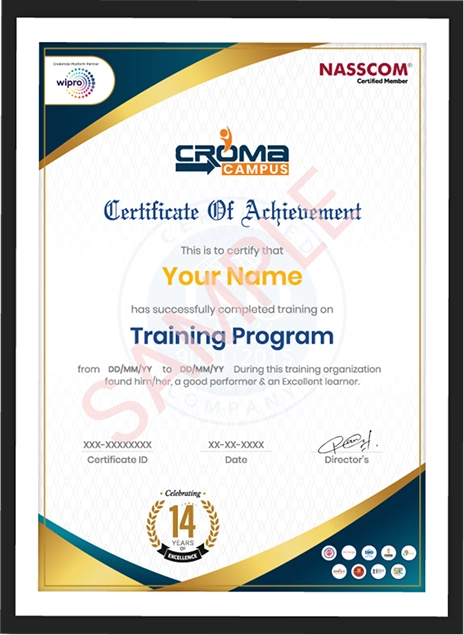
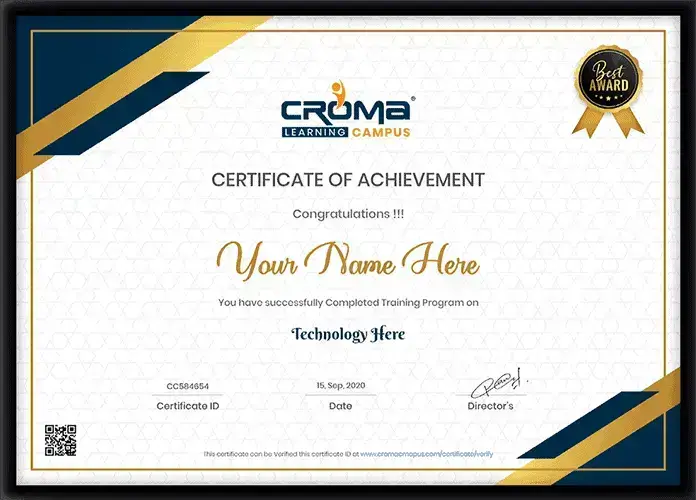
Showcase your Course Completion Certificate to Recruiters

  • checkgreenTraining Certificate is Govern By 12 Global Associations.

  • checkgreen1Training Certificate is Powered by “Wipro DICE ID”
  • checkgreen2Training Certificate is Powered by "Verifiable Skill Credentials"

in Collaboration with

dot-line
Certificate-new-file

Not Just Studying

We’re Doing Much More!

Empowering Learning Through Real Experiences and Innovation

Mock Interviews

Prepare & Practice for real-life job interviews by joining the Mock Interviews drive at Croma Campus and learn to perform with confidence with our expert team.Not sure of Interview environments? Don’t worry, our team will familiarize you and help you in giving your best shot even under heavy pressures.Our Mock Interviews are conducted by trailblazing industry-experts having years of experience and they will surely help you to improve your chances of getting hired in real.
How Croma Campus Mock Interview Works?graph_new

Not just learning

we train you to get hired.

bag-box-form
Request A Call Back

Phone (For Voice Call):

‪+91-971 152 6942‬

WhatsApp (For Call & Chat):

+919711526942
          

Download Curriculum

Get a peek through the entire curriculum designed that ensures Placement Guidance

Course Design By

nasco wp

Course Offered By

Request Your Batch Now

Ready to streamline Your Process? Submit Your batch request today!

WHAT OUR ALUMNI SAYS ABOUT US

View More arrowicon

Students Placements & Reviews

speaker
Manoj Kumar
Manoj Kumar
speaker
Jayad Chaurasiya
Jayad Chaurasiya
speaker
Vikash Singh Rana
Vikash Singh Rana
speaker
Rupesh Kumar
Rupesh Kumar
speaker
Priyanka-Kumari
Priyanka-Kumari
speaker
Ravinder Singh
Ravinder Singh
View More arrowicon

FAQ's

Manual QA processes are taught directly applicable in Agile processes

Yes, full testing templates and reports are provided for practi

Yes, our charges include ISTQB exam coaching and mock tests.

Actual projects allow you to confidently describe scenarios to interviewers.

Yes, fees encompass placement guidance, resume sessions, and interview preparation.

Career Assistancecareer assistance
  • - Build an Impressive Resume
  • - Get Tips from Trainer to Clear Interviews
  • - Attend Mock-Up Interviews with Experts
  • - Get Interviews & Get Hired

Our learners
transformed their careers

highest
35 Laks

Highest Salary Offered

money
50%

Average Salary Hike

building
30K+

Placed in MNC’s

setting
15+

Year’s in Training

alumini
A majority of our alumni

fast-tracked into managerial careers.

Get inspired by their progress in the

Career Growth Report.

FOR VOICE SUPPORT

FOR WHATSAPP SUPPORT

sallerytrendicon1

Get Latest Salary Trends

×

For Voice Call

+91-971 152 6942

For Whatsapp Call & Chat

+91-9711526942
newwhatsapp
1
//