




whatsapppopupnewiconGUIDE ME

Become a job-ready Java Full Stack Developer with hands-on training, real projects, and expert guidance in Visakhapatnam

5 out of 5 based on 42537 votes
google4.2/5
Sulekha4.8/5
Urbonpro4.6/5
Just Dial4.3/5
Fb4.5/5

In collaboration with

115 Hrs.

Duration

Online/Offline

Format

LMS

Life Time Access

Book A Free Counselling Session

we train you to get hired.

bag-box-form
Request more information_

  • With the rapid pace of the IT sector nowadays, organisations require developers to work on the front-end and back-end of web applications. This is where a Java Full Stack Development training course comes into play. If you are based in Visakhapatnam and wish to develop web applications from scratch, this course will take you through all of this step by step. From interface designing to integrating it with databases and deploying it on the server, you will learn everything in Java Full Stack Training in Visakhapatnam.
  • This Visakhapatnam course includes all one needs to be a full stack web developer with Java. It marries the strength of Java programming with current front-end technologies such as HTML, CSS, JavaScript, and Angular or React. Java Full Stack Training in Visakhapatnam also deals with creating REST APIs with Spring Boot, database management, and applications deployment on servers or the cloud.

Java Full Stack Developer Course in Visakhapatnam

About-Us-Course

  • The objective of Java Full Stack Classes in Visakhapatnam is to educate students and professionals in the entire process of web development with Java. It aims to make learners comfortable with performing both client-side and server-side development tasks.
  • Major course goals
    • To enable learners to know how a full stack application works with Java.

      To encourage students to write clean, optimized Java code for the backend.

      To educate on how to create front-end interfaces with HTML, CSS, and JavaScript.

      To facilitate the creation of secure and scalable APIs with Spring Boot.

      To practice connecting applications to databases and designing SQL queries.

      To expose students to version control and DevOps tools such as Git and Jenkins.

      To equip students for job positions through practical projects and interview preparation.

  • This Java Full Stack training in Visakhapatnam is designed to make your learning experience smooth, hands-on, and job-focused. It encompasses various learning formats, live sessions, and doubt-clearance assistance
    • Flexibility through online and offline classes.

      Practical real-time classes with code examples that work.

      Access to recorded classes after each class.

      Weekly assignments and mini projects for each module.

      Step-by-step guidance for developing a full stack application from scratch.

      Soft skills, resume preparation, and mock interviews covered.

      Doubt-clearing sessions after every module.

  • Eligibility
    • This course is ideal for anyone who wishes to become a developer. Whether you are from a non-coding background or coding background, Java Full Stack Classes in Visakhapatnam develop your knowledge from scratch.

  • Anyone from students to freshers, non-IT professionals, and beginners can join the course, as it starts from basics and builds full stack skills.
    • B.Tech, BCA, MCA, or M.Sc. (IT) students

      Final year students of college searching for placement assistance

      Working professionals from non-IT backgrounds

      Freshers who want to prepare for technology positions

      Junior programmers who want to know full stack development

  • After attending this course, the learners will have various job offers both in product-based and service-based firms. Full stack developers are sought after because they can handle both front-end and back-end systems.
  • Scope of the course includes
    • Career opportunities in IT parks and IT hubs of Visakhapatnam.

      Capability to work in startups or MNCs requiring full stack proficiency.

      Freedom to work as a freelance full stack developer.

      Your own startup or web application product to create.

      Job opportunities worldwide with remote work accessibility.

  • Java Full Stack Course is segmented into technical modules, teaching a single skill at a time. Each module comes with practical assignments and live coding examples
    • Core Java

      Variables, loops, OOPs concepts

      Exception handling and file handling

      Advanced Java

      JDBC, Servlets, JSP

      MVC architecture

      Front-End Development

      HTML, CSS, Bootstrap

      JavaScript, DOM, ES6

      JavaScript Framework

      Angular or React (depending on choice)

      Component-based development

      Spring & Spring Boot

      Dependency Injection, Spring MVC

      RESTful APIs and Spring Security

      Database Management

      MySQL/PostgreSQL setup

      Writing SQL queries and joins

      DevOps and Tools

      Git, Maven, Jenkins basics

      CI/CD and cloud deployment

      Final Project

      Complete Full Stack Application

      Code review and deployment practice

  • Java Full Stack Course in Visakhapatnam not only trains you but also makes you eligible to obtain Java Full Stack Training Completion Certificate which recruiters also value. These certificates enhance your resume and certify your skill set.

  • Upon finishing the Java Full Stack Course in Visakhapatnam, students can anticipate a decent salary in the IT sector. Though the salary is based on skills and interview performance, most of the freshers receive a good starting compensation.
    • Initial salaries ranging from 3.5 LPA to 6 LPA.

      Better remuneration for the project-performing and assessment-scoring individuals.

      Remote work with international clients paying 40K60K/month.

      Freelance project income between 20K50K per project.

  • This course will help you construct your long-term career. After gaining confidence in Java Full Stack skills, you can develop into high-level positions with improved salary.
    • Begin as Junior Developer or Intern

      Transition to Full Stack Developer in 1 year

      Become Senior Developer in 23 years

      Progress to Tech Lead or Software Architect after 5+ years

      Option for becoming Cloud Developer, DevOps Engineer, or Freelancer

  • Several students and professionals in Visakhapatnam are opting for this course due to its high demand and hands-on learning structure. Domestic companies are looking for full stack developers, so Java Full Stack Developer Course in Visakhapatnam is immensely relevant.
    • Sufficient job demand in Visakhapatnam's burgeoning IT industry.

      Optimal blend of theory and practical practice in the course.

      Local institutes providing live training and placement support.

      Cost-effective compared to courses in metro cities.

  • Once the course is completed, youll be ready for a range of job roles in the software development field. These roles require both front-end and back-end development skills.
    • Java Full Stack Developer

      Software Engineer (Java)

      Backend Developer

      Frontend Developer (Angular/React)

      Web Application Developer

      API Developer

  • Java Full Stack proficiency is needed in all industries. This course makes you proficient for jobs in several sectors.
    • IT Services and Consulting

      Product-based organisations

      E-Commerce and Retail

      Healthcare and Pharma Technology

      Logistics and Supply Chain

      Banking and Finance

  • With expert trainers, hands-on projects, flexible batches, GitHub portfolio help, and strong placement support, we offer the best Java Full Stack training in Visakhapatnam.
    • Selecting the right training institute plays a big role in shaping your career, especially when you are learning a job-oriented course like Java Full Stack Development. At our institute in Visakhapatnam, we do much more than just teach we guide you step by step toward a real career in tech. Java Full Stack Developer Course in Visakhapatnam is designed not only to build your technical skills but also to make sure you are fully prepared to work in the industry.

      We have trainers who come with 8+ years of real industry experience. Theyve worked on live projects for big companies and know what companies actually expect from full stack developers. That means you dont just get textbook knowledge you learn how the real-world software development process works.

      Our classes are practical and hands-on, not boring theory lectures. Every topic is explained with working code, examples, and real-time assignments. We help you create your own GitHub portfolio so that you can showcase your skills when applying for jobs. This is something employers actively look for.

      We also offer job alerts, resume building help, mock interviews, and one-on-one guidance to help you crack interviews with confidence. You will never feel like you are learning alone our trainers and support team are with you at every step.

      The course is flexible too. Whether you are a student or a working professional, you can choose weekday or weekend batches based on your schedule.

  • Get expert-led practical training, real projects, GitHub portfolio support, flexible batches, and full placement assistance for a strong tech career.
    • Trainers with 8+ years of actual industry experience.

      Practical sessions, no theory-only dull classes.

      Job alerts and interview preparation with placement support.

      Weekend and weekday batches available.

      Live projects, GitHub portfolio assistance, and interview readiness.

Why Should You Learn Java Full Stack?

Not just learning

we train you to get hired.

bag-box-form
Request more information

By registering here, I agree to Croma Campus Terms & Conditions and Privacy Policy

CURRICULUM & PROJECTS

Java Full Stack Development with DSA + AI

    Introduction

    • Software architecture and its flow to design a layout
    • Technologies needed For Full Stack
    • Current market requirements on UI/UX
    • Difference between UI/UX design
    • UI/UX Developer roles and Responsibilities
    • Figma design and prototypes

    HTML5

    • Basics
      • HTML5 & difference between previous versions
      • Structure of HTML Page & DOM
      • Tags, Attributes, HTML Elements, Style attribute
      • Heading tags (H1H6), Tags, Paragraph tag
      • Typography, Inserting images & formats, Margin, Padding, Borders
      • Hyperlinks, buttons, Colors
      • Create layout using div and section tags
      • Difference between Inline and block-level elements
      • Table, Lists, Forms & Controls, Inserting Maps
    • HTML5
      • Header, Footer
      • iFrames, Audio, Video tags

    CSS 3

    • Introduction
      • CSS3 and difference with previous versions
      • CSS Types, Syntex, Property Values
      • Selectors, Box Model, DOM
      • Background, Display, Position, height & width and other properties
    • More Properties
      • CSS Overflow, blur, opacity
      • CSS Float and Clear
      • Pseudo Class and Element
      • Animations with keyframes
      • box shadow
      • Transform, translate, transition Property
      • Flexbox property in depth and web fonts
      • Web page layout and Media Queries

    JavaScript

    • Introduction, History and Syntax
    • How to use JS in different ways
    • Popup Boxes, alerts, prompt, confirm
    • Variable type
    • Data Types
    • Operators
    • Conditional Statements & Loops
    • Functions
    • Arrays & Strings
    • Events
    • Object and its property
    • This keyword
    • RegExp
    • ErrorHandling & async-await conepts

    Bootstrap 5

    • Introduction
    • Bootstrap5 and comparison with previous versions
    • How to download or start with CDN
    • Grid System and Flex Concept in bootstrap 5
    • Typography, Colors, Buttons
    • Images, tables, Alerts, Badges, spinner
    • Cards, Pagination, list groups
    • Dropdown and collapse concept
    • Responsive Forms (Contact Form)
    • Navbar and footer
    • Carousel and Modal
    • Tooltip, popover and Toast
    • Scroll spy and offcanvas
    • Utilities

    jQuery

    • Introduction and uses
    • Selectors and Events in jQuery
    • jQuery Effects
      • Hide/Show, Fade, Slide, Animate, stop(), call back
    • jQuery HTML
      • get, set, add/remove, CSS classes, css()
    • jQuery Traversing
      • Finding elements using jQuery techniques & Filtering elements
    • jQuery AJAX
      • Advantages with Ajax and its limitations
      • Samples working with Ajax
      • Different data formats used in Ajax (string, xml, Json, etc)
      • XML and JSON difference
Get full course syllabus in your inbox

    Concept of Modern JavaScript (ES6)

    • Introduction to ECMAScript 2015
    • Modern Java Script and React js
    • Var, Let and Const in JavaScript
    • Template literals (Template strings) in ES6
    • New Strings Methods in ES6
    • Array Destructuring & Object Destructuring in ES6
    • Fat Arrow Function
    • Default & REST Parameters in ES6
    • Spread Operator in ES6
    • New Array Methods in JavaScript
    • New Numbers & Global Methods
    • OOPS (Classes, Object & Inheritance) in ES6
    • Async Await in JavaScript
    • Error Handling in JavaScript
    • Fetch API in Promises in JavaScript

    React Modules

    • Introduction, prerequisites and uses
    • Package Manager (yarn, npm, pnpm, bun with vite)
    • Environment Setup, download and install with VS Code
    • Basic Syntex and Folder Structure
    • JSX and Java script Expression in JSX
    • React Components (Functional Components)
    • Render Multiple Elements (React fragment)
    • Module import and Export
    • Inserting images in react
    • CSS styling in React
    • JS Map Method & key concept in react
    • Conditional rendering in react
    • Arrays in React
    • Props Concepts in react
    • Event Propagation in react
    • Bootstrap in React
    • Hooks Concept
    • State Management (useState)
    • useEffect
    • useContext
    • useCallback
    • useParam
    • useNevigate
    • useRef
    • useReducer
    • Router and create a navbar in react
    • Use Bootstrap5 in React
    • Fetch API Data in React
    • Axios With Get & Post
    • Form in React with Login Form Submition
    • Component Lifecycle
    • Mounting and Unmouting in react
    • Animations in React
Get full course syllabus in your inbox

    Arrays

    • Traversal, insertion, deletion
    • Searching & sorting (binary search, merge sort, quick sort)
    • Two-pointer technique
    • Sliding window

    Strings

    • String manipulation (palindrome, anagram, substring)
    • Pattern matching
    • StringBuilder vs StringBuffer
    • Regex basics

    Linked Lists

    • Singly & doubly linked list
    • Reversal, cycle detection (Floyd's algorithm)
    • Merge two sorted lists

    Stacks & Queues

    • Stack using array/linked list
    • Infix, postfix, prefix expressions
    • Queue, Circular Queue, Priority Queue
    • Deque

    Recursion

    • Basic recursion patterns
    • Backtracking

    Hashing

    • HashMap, HashSet
    • Frequency count, duplicates

    Trees

    • Binary Tree, Binary Search Tree (BST)
    • Traversals (in-order, pre-order, post-order)
Get full course syllabus in your inbox

    Introduction:

    • Java History and Versions
    • Differences between java and others
    • Java Features
    • Java Naming Conventions

    Java Architecture

    • Introduction to Java architecture: JDK, JRE, and JVM.
    • Java Installation and setup with VS code
    • Text-Editors
    • Run and Compile a Java Files
    • Explain the Java file Structure

    Language Fundamentals

    • Operators
    • Identifiers
    • Literals
    • Data Types and Type casting
    • Java Statements
    • Arrays
    • Variable and Identifiers
    • Data Types and Type casting
    • Tokens and Literals in Java
    • Operators
    • Arrays and Strings in Java
    • User input with Scanner Class
    • Control Flow Statement in java
      • Decision Making Statements :- If-else and switch statement
      • Loop Statement :- While, do-while, for and for-each loops

    Methods in Java

    • Create and Call Methods
    • Parameters and Arguments
    • Recursion in Methods
    • Method Overloading & Scopes

    OOPS

    • Introduction
    • Class and Objects
    • Attributes and Methods with example
    • Constructors and its parameters
    • Modifiers
      • Access
      • Non-Access
    • Encapsulations
    • Inheritance concept
    • Overloading Vs Overriding
    • Polymorphism in Java
    • Static, This and final Keyword in java
    • Abstract class and method in java
    • Interfaces in java
    • Enums in Java
    • Types of classes
      • Nested classes
      • Member inner Class
      • Anonymous Inner class
      • Local Inner class
      • Static nested class
    • Exceptional handling in Java
    • Regular expression (RegEx) in Java
    • I/O Streams in Java
    • Generics in java

    Packages:

    • What is a package
    • Types of packages
      • Predefined packages
      • User defined packages

    Reflection API:

    • Class
    • Field
    • Method
    • Constructor

    Garbage Collection:

    • Introduction
    • Approaches to make an object for GC
    • Methods for requesting JVM to run GC
    • Finalization
Get full course syllabus in your inbox

    Collection Framework

    • Collection Architecure
    • List and its implementations
      • Array List
      • LinkedList
      • List Sorting
    • Hash Set
    • Hash Map
    • Queue and its implementations
      • Priority Queue
      • De-queue
      • Priority Blocking Queue
      • Linked Blocking Queue
    • Iterators
      • Iterator
      • List Iterator
    • Collectors

    Java 8 features

    • Lambda Expressions
      • Functional Interfaces
    • Stream APIs
    • Date and Time APIs
    • Java 8 features into collection framework
    • MultiThreading
      • Concept of thread
      • Race condition
      • Thread Pooling

    JSP and Servlet

    • Introduction to Web Development
      • Overview of Web Technologies
      • Difference between Java Servlets and CGI
      • Introduction to Java EE
      • Understanding Web Servers and Application Servers
      • Setting Up the Development Environment (Eclipse/VS Code with plugins)
    • Three layer architecture
      • View layer
      • Service layer
      • DAO layer
    • Servlet Basics
      • Introduction to Servlets
      • Servlet Lifecycle (init, service, destroy)
      • Writing Your First Servlet
      • Deployment Descriptor (web.xml)
      • Servlet Mapping and URL Patterns
      • Handling GET and POST Requests
      • ServletConfig and ServletContext
    • Advanced Servlet Concepts
      • Request Dispatching (forward and include)
      • Session Management (Cookies, HttpSession, URL Rewriting)
      • Servlet Filters
      • Error Handling in Servlets
    • Introduction to JSP
      • Understanding JSP and its Advantages
      • JSP vs. Servlets
      • JSP Lifecycle
      • Writing Your First JSP Page
      • Scripting Elements
      • JSP Directives & Actions
      • JSP Implicit Objects (request, response, session, config)
    • Advanced JSP Concepts
      • JSP Actions and Custom Tags
      • Error Handling in JSP
    • Integrating JSP and Servlets
      • Passing Data between Servlets and JSP
      • Using JSP as a View Layer
      • Application Design with JSP and Servlets

    JDBC

    • Introduction to JDBC
      • Overview of JDBC: What is JDBC, Importance of JDBC in Java applications, JDBC Architecture and API components
      • Setting Up the Environment: (Installing and setting up JDK, Configuring a database (e.g. MySQL)
    • JDBC Basics
      • Understanding JDBC Drivers
      • Connecting to a Database: (JDBC URL, Username, and Password)
      • Establishing a connection using DriverManager, Handling SQLException and understanding error codes)
    • Advanced JDBC Concepts
      • Prepared Statement in JDBC
      • Batch Processing: (Introduction to batch processing, Adding multiple queries to a batch)
      • ResultSets in JDBC
    • Transaction Management
      • Introduction to Transactions
      • Managing Transactions in JDBC
    • Connection Pooling
      • Introduction to Connection Pooling:
      • Implementing Connection Pooling
    • Error Handling in JDBC
      • Error Handling in JDBC
    • Security in JDBC Applications
      • Preventing SQL Injection
    • Deployment of JDBC
      • Packaging and Deploying JDBC Applications
      • Maintaining and Scaling JDBC Applications

    Hibernate Framework

    • Introduction to Hibernate
      • What is Hibernate (Overview of Object-Relational Mapping (ORM)
      • Setting Up Hibernate
    • Basic Hibernate Concepts
      • Hibernate Configuration (Understanding hibernate.cfg.xml., Configuring database connection settings.)
      • Creating Your First Entity (Annotating a Java class with @Entity., Defining primary keys with @Id.)
      • Basic CRUD Operations
    • Mapping Relationships
      • One-to-One Relationship
      • One-to-Many and Many-to-One Relationships
      • Many-to-Many Relationshi
    • Querying with Hibernate
      • Hibernate Query Language (HQL) (Writing basic HQL queries to retrieve and manipulate data, Using parameters in HQL queries.)
      • Criteria API (Introduction to Criteria API for building queries programmatically.)
      • Native SQL Queries (Executing native SQL queries and mapping results to entities.)
    • Performance Optimization
      • Caching (Introduction to first-level cache., Basic overview of second-level caching (optional for beginners).)
      • Lazy vs. Eager Loading (Understanding fetch strategies and their impact on performance.)

    Spring and Spring Boot

    • Introduction to Spring Framework
      • Overview of Spring Framework
      • Importance and Benefits of Spring
      • Core Components of Spring
      • Setting up a Spring Project
    • Spring Core Concepts
      • Inversion of Control (IoC) and Dependency Injection (DI)
      • Understanding IoC and DI
      • Configuring Beans in Spring
      • Spring IoC Container and Application Context
      • Spring Beans
      • Bean Lifecycle
      • Bean Factory vs. ApplicationContext
      • Spring Configuration
    • Annotations and @Autowired in Spring
      • Spring Annotations Overview
      • Introduction to Annotations in Spring
      • Commonly Used Annotations
      • Core Annotations
      • Repository ,Controller, Service
      • @Configuration and @Bean
      • Dependency Injection Annotations
      • @Autowired
      • @Qualifier and @Primary
      • @Value for Property Injection
    • Spring AOP (Aspect-Oriented Programming)
      • Introduction to AOP
      • AOP Concepts
      • Using AOP in Spring
    • Three-Layer Architecture in Spring
      • Introduction to Three-Layer Architecture
      • Overview of Presentation, Service, and Data Access Layers
      • Importance of Layered Architecture in Software Development
      • Presentation Layer
      • Handling User Inputs and Displaying Outputs
      • Controllers in Spring MVC
      • View Technologies (JSP, Thymeleaf)
      • Service Layer
      • Business Logic Implementation
      • Creating and Managing Services
      • Service Interfaces and Implementations
      • Data Access Layer
      • Interaction with Databases
      • Repositories and DAOs in Spring
      • Using Spring Data JPA for Data Access
    • Spring Data Access
      • Spring JDBC
      • Introduction to Spring JDBC
      • Setting Up JDBC (mySQL) in Spring
      • Data Source Configuration
      • Application.properties uses
      • DAO Support Classes
      • Spring ORM
      • Overview of ORM and JPA
      • Integrating Hibernate with Spring
      • Spring Data JPA
      • Transaction Management
      • Programmatic vs. Declarative Transactions
      • Transaction Propagation and Isolation Levels
    • Spring MVC
      • Introduction to Spring MVC
      • MVC Design Pattern
      • Setting up Spring MVC Project
      • Controllers
      • Creating Controllers
      • Request Mapping and Response Handling
      • Form Handling in Spring MVC
      • Views
      • View Resolvers and View Technologies (JSP)
      • Model and Model And View
      • Validation and Exception Handling
      • Input Validation in Spring MVC
      • Global and Controller-Level Exception Handling
    • Introduction to Spring Boot
      • Advantages of Spring Boot
      • Spring Boot Architecture
      • Setting up a Spring Boot Project with Spring initializer and VS Code
    • Spring Boot Core Concepts
      • Spring Boot Starters
      • Understanding Spring Boot Starters
      • Commonly Used Starters
      • Spring Boot Auto Configuration
      • Auto Configuration Overview
      • Customizing Auto Configuration
      • Spring Boot Configuration
      • Profiles in Spring Boot
      • POM.xml
      • Beans
      • Spring Boot DevTools
      • Enabling and Using Spring Boot DevTools
    • Building RESTful Web Services with Spring Boot
      • Introduction to RESTful Web Services
      • Creating RESTful Services(CRUD) in Spring Boot
      • Handling HTTP Methods (GET, POST, PUT, DELETE)
      • Content Negotiation and Versioning
      • Exception Handling in RESTful Services
      • Securing REST APIs with Spring Security
    • Spring Boot Data Access
      • Spring Data JPA with Spring Boot
      • Setting up Spring Data JPA in Spring Boot
      • Creating Repositories
      • Query Methods and Custom Queries
      • Spring Boot with Relational Databases
      • Using MySQL with Spring Boot
    • Spring Boot Testing
    • Spring Security
      • Introduction to Spring Security
      • Securing Web Applications
      • Role-Based Access Control
      • Spring Security XML Based Example
      • Spring Security Java Based Example
    • Microservices with Spring Boot
      • Introduction to Microservices Architecture
      • Building Microservices with Spring Boot
      • Service Discovery with Eureka
      • API Gateway with Spring Cloud Gateway
      • Circuit Breakers with Resilience4j/Hystrix
      • Distributed Tracing with Spring Cloud Sleuth
    • Advanced Spring Boot Features
      • Spring Boot Actuator
      • Monitoring and Managing Spring Boot Applications
      • Customizing Actuator Endpoints
    • Capstone Projects
      • Project
      • Employee Management application with CRUD operations using Spring Boot. This will cover creating, reading, updating, and deleting employee records with three layer architecture.
Get full course syllabus in your inbox

    Introduction to AI & ML

    • What is AI What is ML What is Deep Learning
    • AI vs ML vs DL
    • Where AI fits in web development
    • Real-world examples
    • Objective: Build interest and clarity in the AI landscape.

    Weka ML for Beginners

    • Introduction to Weka
    • Explore Weka GUI: load CSV, run classifiers

    Encog Lightweight Neural Networks in Java

    • Introduction to Encog
    • Creating a small feedforward neural network

    DL4J Deep Learning in Java

    • What is DL4J (DeepLearning4J)
    • Understanding layers, activations, loss functions

    Spring AI API Overview Modern AI Services

    • What is Spring AI
    • Overview with OpenAI, Hugging Face, and others
    • Prompt templates and responses
Get full course syllabus in your inbox

+ More Lessons

Course Design By

naswipro

Nasscom & Wipro

Course Offered By

croma-orange

Croma Campus

Real

star

Stories

success

inspiration

person

Abhishek

career upgrade

person

Upasana Singh

career upgrade

person

Shashank

career upgrade

person

Abhishek Rawat

career upgrade

SELF ASSESSMENT

Learn, Grow & Test your skill with Online Assessment Exam to
achieve your Certification Goals

right-selfassimage
Get exclusive
access to career resources
upon completion
quote
Mock Session

You will get certificate after
completion of program

laptop
LMS Learning

You will get certificate after
completion of program

star
Career Support

You will get certificate after
completion of program

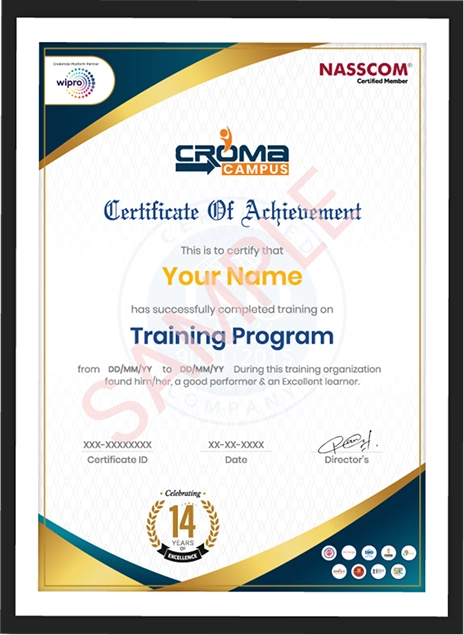
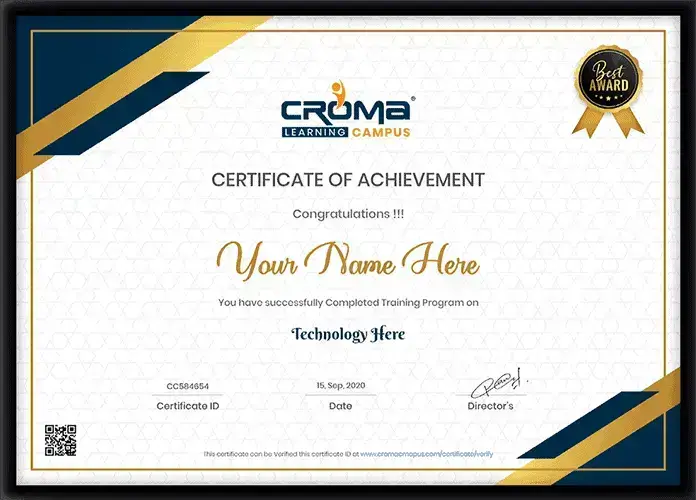
Showcase your Course Completion Certificate to Recruiters

  • checkgreenTraining Certificate is Govern By 12 Global Associations.

  • checkgreen1Training Certificate is Powered by “Wipro DICE ID”
  • checkgreen2Training Certificate is Powered by "Verifiable Skill Credentials"

in Collaboration with

dot-line
Certificate-new-file

Not Just Studying

We’re Doing Much More!

Empowering Learning Through Real Experiences and Innovation

Mock Interviews

Prepare & Practice for real-life job interviews by joining the Mock Interviews drive at Croma Campus and learn to perform with confidence with our expert team.Not sure of Interview environments? Don’t worry, our team will familiarize you and help you in giving your best shot even under heavy pressures.Our Mock Interviews are conducted by trailblazing industry-experts having years of experience and they will surely help you to improve your chances of getting hired in real.
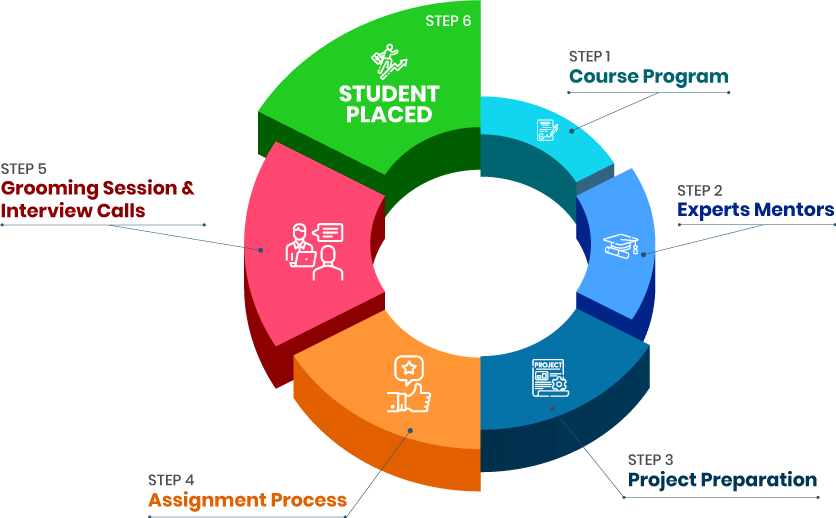
How Croma Campus Mock Interview Works?graph_new

Not just learning

we train you to get hired.

bag-box-form
Request A Call Back

Phone (For Voice Call):

‪+91-971 152 6942‬

WhatsApp (For Call & Chat):

+919711526942
          

Download Curriculum

Get a peek through the entire curriculum designed that ensures Placement Guidance

Course Design By

nasco wp

Course Offered By

Request Your Batch Now

Ready to streamline Your Process? Submit Your batch request today!

WHAT OUR ALUMNI SAYS ABOUT US

View More arrowicon

Students Placements & Reviews

speaker
Prayojakta
Prayojakta
speaker
Saurav Kumar
Saurav Kumar
speaker
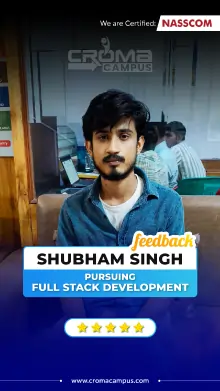
Shubham Singh
Shubham Singh
speaker
Vikash Singh Rana
Vikash Singh Rana
speaker
Harikesh Panday
Harikesh Panday
speaker
Priyanka-Kumari
Priyanka-Kumari
View More arrowicon

FAQ's

No, the course is meant for beginners. You will begin with foundational topics and progress to advance gradually.

Yes. Placement support comes with mock interviews, resume advice, and referrals to companies.

The course typically lasts 4–6 months, based on your chosen learning mode (weekend or regular batch).

Yes, we have online live training as well as classroom classes in Visakhapatnam.

Yes. Each student has at least 2–3 full stack real-world projects completed by the end of the course.

Career Assistancecareer assistance
  • - Build an Impressive Resume
  • - Get Tips from Trainer to Clear Interviews
  • - Attend Mock-Up Interviews with Experts
  • - Get Interviews & Get Hired

Our learners
transformed their careers

highest
35 Laks

Highest Salary Offered

money
50%

Average Salary Hike

building
30K+

Placed in MNC’s

setting
15+

Year’s in Training

alumini
A majority of our alumni

fast-tracked into managerial careers.

Get inspired by their progress in the

Career Growth Report.

FOR VOICE SUPPORT

FOR WHATSAPP SUPPORT

sallerytrendicon1

Get Latest Salary Trends

×

For Voice Call

+91-971 152 6942

For Whatsapp Call & Chat

+91-9711526942
newwhatsapp
1
//