Course Design By
Course Offered By
 GUIDE ME
This DevOps training is made for freshers, working people, and anyone who wants to move into IT. The course explains how software is built, tested, and released in real companies. You learn how DevOps teams actually work in daily office life.
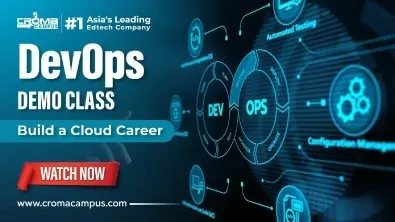

Attend our DevOps Online Training Demo Class to experience real-time training before you enroll.

Rohit Shah
Placed at Capgemini

Ankit Mishra
Placed at Microsoft

Gopal Singh
Placed at Infosys

Pawan Kumar
Placed at IBM

Vinod Sharma
Placed at Wipro

Manoj Prasad
Placed at Deloitte

Suman Sharma
Placed at TCS

Gita Singh
Placed at Accenture

This DevOps Online Training delivers in-depth DevOps Online training on DevOps principles, processes, and tools utilized in modern software environments. Topics include model management, non-stop integration, automation, infrastructure as code, and tracing. DevOps online training with hands-on experience of equipment like Git, Jenkins, Docker, Kubernetes, Ansible and Terraform ensures commonsense knowledge of DevOps concepts. This DevOps Online Course with placement helps you prepare for jobs like AWS Certified DevOps Engineer, Junior DevOps Engineer, Build Engineer, and Cloud DevOps Engineer.
What you get
Course Design & Approved By

Nasscom & Wipro
This DevOps Online Training in India starts from the basics. It slowly moves to real work. You learn how code moves from development to production in real companies.
Get a peek through the entire curriculum designed that ensures Placement Guidance
Course Design By


Course Offered By

Top Job Profiles:
Average Salary Range:
Top Job Profiles:
Average Salary Range:
Top Job Profiles:
Average Salary Range:
Top Job Profiles:
Average Salary Range:
This DevOps Online Training in India helps you gain real skills that companies look for. The focus is on real work, not book language.
Our DevOps training is led by a highly experienced industry professional with extensive real-world expertise. The trainer brings practical insights from working on live enterprise projects, ensuring learners.
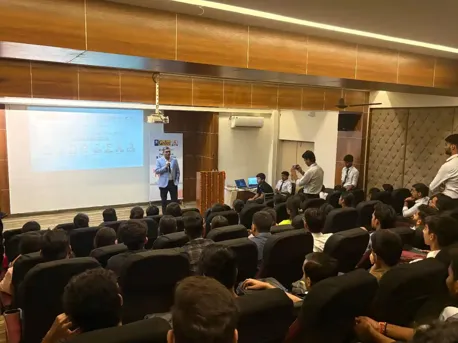
You learn DevOps basics, tools, automation, CI/CD, cloud basics, and real project work.
Yes. The course starts from the basics. No prior knowledge is needed.
No heavy coding is needed. Basic commands are taught step by step.
Yes. You practice every topic during the training.
You work on pipelines, automation tasks, deployments, and monitoring setups.
Yes. Training includes real work tasks used in companies.
Yes. Resume help, interview guidance, and job support are included.
Yes. Classes are flexible and easy to follow for working people.

What is DevOps
DevOps Lifecycle & Ecosystem
DevOps Market Trends
DevOps Engineer Roles & Responsibilities
Introduction to Cloud Computing
Why DevOps on Cloud
Introduction to AWS
SDLC vs DevOps
Agile & Scrum Basics
Git Internals & Workflows
Branching Strategies (GitFlow)
Merge vs Rebase
GitHub Integration & PR workflows
Hands-on on Bitbucket and GitHub both with command line
Docker Architecture & Lifecycle
Dockerfile Optimization (Multi-stage builds)
Docker Compose (Multi-container apps)
Networking & Volumes
Kubernetes Architecture (Control Plane + Nodes)
Deployments, Services, Ingress
Pod creation
Deployment and Replicate deployment via Pipeline
Scaling & Auto-healing
Terraform Core Concepts & Workflow
State Management & Backends
Modules & Reusability
Multi-cloud Deployment
Setting up Docker Engine
Upgrading Docker Engine
Kubernetes Core Concepts
Kubectl common commands
Understanding Pods
Configure network on cluster nodes
Pod Networking Concepts
Setting up a cluster - Kubernetes Certificates
Perform basic Kubectl commands
Deploy pods and use INIT containers to pre-set an environment
Configure Kubernetes network using Calico
Use certificates to authenticate resources
Persistent Volume and Persistent Volume Claim
Access modes for volumes
Primitives for Persistent Volume Claim
Secrets and Config Maps in your pods
Storage classes
Headless services
Stateful Sets
Deploy Persistent Volume and Persistent Volume Claim
Use Secrets and Config Maps in your applications
Use Storage Class for dynamic storage allocation
Use stateful applications for sticky identities for pods
Deploy a highly available replicated MariaDB cluster
Authentication
Authorization
Kubernetes security primitives
Configure Network Policies
Security Contexts
Create and use Roles and Role Bindings
Define custom Egress and Ingress policies
Use probes and configure a restart policy for pods
Define privilege and access control using security contexts
Hosts and Users
Variables
Tasks
Handlers
Jinja2 Templates
Persistent Volume and Persistent Volume Claim
Access modes for volumes
Primitives for Persistent Volume Claim
Secrets and Config Maps in your pods
Storage classes
Headless services
Stateful Sets
Deploy Persistent Volume and Persistent Volume Claim
Use Secrets and Config Maps in your applications
Use Storage Class for dynamic storage allocation
Use stateful applications for sticky identities for pods
Deploy a highly available replicated MariaDB cluster
we train you to get hired.

Phone (For Voice Call):
+91-828 706 0032WhatsApp (For Call & Chat):
+91-828 706 0032
Scenario: Tech Mahindra planned a complete DevOps workflow.
Outcome: Automated workflow with robust CI/CD pipeline

Scenario: Cognizant planned to move applications with DevOps support.
Outcome: Enabled smooth application migration with DevOps

Scenario: Wipro needed smooth build and release flow.
Outcome: Improved version control and release visibility

Scenario: TCS wanted secure DevOps pipelines.
Outcome: Reduced risks using secure DevOps best practices

Scenario: Infosys – Infrastructure Automation
Outcome: Reduced configuration errors with IaC tools

Scenario: Capgemini needed better system tracking.
Outcome: Enabled real-time system monitoring dashboards

Scenario: Deloitte wanted to reduce manual deployment work.
Outcome: Improved reliability through automated testing

Scenario: Accenture needed faster and smoother software releases.
Outcome: Eliminated manual builds with automated workflows
Company: Deloitte
Location: India
Experience: 0–2 Years
Required Skills: DevOps experience, security basics, decision-making
Company: Junior DevOps Engineer
Location: India
Experience: 0–2 Years
Required Skills: basic knowledge, labs Practice, learning new tools
Company: Infosys
Location: India
Experience: 1–3 Years
Required Skills: DevOps basics, tools practice, daily problem-solving
Choose from our specialized DevOps modules designed for all learning levels.
Learn AWS cloud fundamentals online, covering core services, security, deployment, and real-world hands-on skills.
Become a DevOps expert mastering CI/CD, cloud, automation, containers, monitoring, and real-world tools.
Azure DevOps helps teams build, test, and deploy apps faster using integrated CI/CD, source control, and automation.
DevOps helps automate deployments, manage cloud systems, and deliver secure, scalable apps efficiently.
For Voice Call
+91-971 152 6942For Whatsapp Call & Chat
+91-9711526942Share some of your details and we will be in touch with you for demo details, and know about Batches Available with us!


 +91-828 706 0032
 +1 (782) 819-0044






 Interested in Course?



.webp)
.webp)

.png)


