
Tricentis Tosca Copilot: Dive Into Features And Benefits
4.9 out of 5 based on 16456 votesLast updated on 29th May 2026 26.6K Views

- Bookmark
Enroll in the Tosca Course to build strong automation testing skills and improve career opportunities in the IT industry.
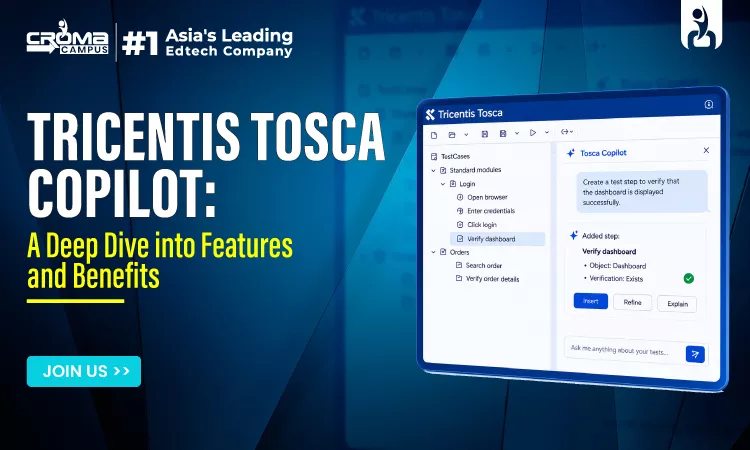
Tosca Copilot by Tricentis is a conversational AI assistant built into its Test Automation solution. It enables QA teams to discover, analyze, and optimize test resources with the power of conversation. Through the use of Large Language Models (LLMs), it multiplies the efficiency of experienced automation engineers as well as that of citizen testers.
Thanks to the capabilities offered by AI, the Tosca Copilot can assist in closing the divide that exists between complexity and ease of use, thereby facilitating the conversation between testers and the Tosca Course through the medium of natural language. This is certainly a significant stride towards full autonomy in testing.
How Tosca Copilot Monitors Your Testing Needs?
Tosca Copilot's continuous monitoring of your testing suite streamlines the overall quality assurance process. Continuous monitoring includes analyzing test cases, identifying redundant steps, and recommending areas for improvement in order to achieve increased overall test coverage. These recommendations are provided in real-time while users move through their workspaces.
Copilot doesn’t just respond to manual inputs; it actively assesses the health of your automation. The system checks if your test logic is consistent across different versions of the application under test. It also measures how fast your team can create new scripts. If a new wave of requirements unexpectedly shows up, the Copilot can step in and help out by providing the required test logic on the spot.
When you run a comprehensive Tosca Certification program, this process is called augmented intelligence: The system learns your existing testing patterns and can help you better over time.
If Tosca Copilot Wants to Speed Up Development
Acceleration is the rapid production of test cases and modules, so the QA team can keep pace with development sprints. That happens when the Copilot understands that the manual mapping of objects has become a major bottleneck in the delivery process.
Typically, this happens when application complexity is very high, there are more and more UI elements to deal with, and time-to-market gets tighter. Nonetheless, the use of advanced algorithms allows the tool to be accurate, since it cannot simply assume what the business process is intended for.
Among other things that should be considered are:
- Complexity of the application's architecture;
- Reusability of some modules;
- Alignment with business needs.
As you realize in the course of a professional Playwright Automation Course, programming gives you control over processes, whereas AI-based acceleration of your tests in Tosca delivers scale.
What Happens When Tosca Copilot Decides to Simplify Maintenance
Maintenance is about detecting and resolving broken test steps because of an alteration in the application's UI. It is done accurately and avoids the infamous problem of 'flaky tests'.
The system determines the cause of an issue as either a temporary glitch or an alteration in application code. Updates will not be suggested until the change to the structure has been verified to be permanent.
The check does the following:
- If the element in question has undergone a permanent change to its technical attributes.
- If the workflow logic is still achieving the desired outcome.
- If the proposed solution aligns with current naming conventions.
The use of "self-healing" scripts is often used in reference to the Selenium Testing Course, while the Copilot in Tosca provides a collaborative process through presenting the user with a solution and asking for their approval.
You May Also Read This Post:
Software Testing Interview Questions
Software Development Engineer in Test
Black Box Testing in Software Engineering
Tosca Certification Cost in India
AI Testing Precision: Why It Matters
The amount of precision in your voice command instructions is crucial for any AI-generated suggestions made by the Tosca Copilot because deep learning models will interpret your natural language commands into properly structured, executable test cases.
The AI needs this level of precision to avoid generating "hallucinations" or incorrect test cases. The purpose of including precision in the test automation suite is to minimize manual rework by ensuring that the automation suite is not error-prone.
Most people realize that, in many of the industry-standard training modules, AI is not a substitute for strategy; it takes human supervision to keep the AI-generated tests reliable and stable.
Different Features Work in Different Ways
Tricentis Tosca has a range of built-in capabilities, and its Copilot works with every capability to provide assistance in enhancing the desired outcomes.
Feature | Form of Enhancement | Type of item that the feature watches for | Specific Item |
| Test Case Design | Logic development | Business parameters | Generates combinations of data |
| Module Scanning | Items within an object | Technical characteristics of that object | Retrieves elements using a description |
| Execution Lists | Reporting | Mode of failure | Summarizes log entries to form coherent paragraphs |
| API Testing | Validation of payloads | Requests/Response | Generates tests from API documentation |
Each one of these features has a different purpose, and therefore, the assistance that the Copilot provides is targeted to the particular technical constraints associated with that feature.
In higher-level training sessions, this information is specifically addressed because if you select the correct feature to assist "Copilot," each member of your team will spend less time working on their task(s) than if they had made incorrect selections.
What is the Effect of Natural Language on Automation?
Natural Language Processing (NLP) is a term used to describe how the Copilot can use "plain English" to create automation.

If a tester speaks simply, the AI will be able to convert their explicit statements into a model-based test step. However, if the user creates a complex document, the AI assists by parsing it and extracting the appropriate test scenarios.
Factors that will affect the above include:
- Onboarding speed for non-tech testers
- Reduction in script writing errors
- Collaboration between BA's and QA
Today, one of the major confit parameters for modern automation is NLP, as it supports democratization of testing across the entire organization.
By using the prompt engineering interface for Copilot, testing can be tailored according to the company’s own internal standards.
Testing is not limited to standard UI Testing, but can be defined by:
- Compliance with specific industry regulations
- Use of custom proprietary frameworks
- Integration into legacy systems
By tailoring the testing to each organization, the automation process will be completely bespoke to that organization.
As such, within the realm of modern QA, this is considered an intelligent approach to scale testing based on the business context as opposed to just using technical scripts.
Common Issues When Using AI Automation
When using AI and integrating it into your organization, it can fail to work 100% correctly out of the box. This generally happens due to 2 reasons:
- Lack of context;
- Poor initial data.
The following are several frequent issues:
- Ambiguous requirements in natural language prompts.
- Too heavy a reliance on AI for edge case occurrences in complex scenarios.
- Concerns regarding the security of sensitive data.
- Initial setup of the AI Model within a Local Environment.
- Learning how to properly communicate with the AI models to receive the best possible results.
There is also a learning curve associated with how to communicate appropriately with the AI models.
In professional training environments, these issues are researched by using actual setups so that better decisions can be made about when to utilize AI and when to use Manual Modeling Methods.
Conclusion
Tricentis Tosca Copilot revolutionizes the testing experience in a simple yet thoughtfully designed way. It observes your application change all the time, waits for your natural language cues, and then takes action to build or fix automation.
It doesn't rush to produce volatile scripts, but checks the logic is sound before finishing a module. This tool is a cornerstone for anyone who wants to excel in the Tosca Course. The future of QA with AI is not just about finding bugs but about creating a more resilient and faster software delivery engine.
Subscribe For Free Demo
Free Demo for Corporate & Online Trainings.
Course Features
 Reals Life Practical & Case Studies
 Assignments
 Lifetime Access
 Expert Support
 Global Certification
 Job Portal Access
RELATED BLOGS
Master Automation Testing – Selenium, Tosca And Playwright In 2026
Tricentis Tosca Copilot: Dive Into Features And Benefits
Playwright And Software Testing Full Guide With Interview Q&A

Software Testing Still A Good Career In 2026? Complete Analysis

How AI Tools Are Revolutionizing Playwright Automation?
How Playwright Helps Find Hidden Visual Bugs In UI Tests?

What Is Tosca? Step-by-Step Beginner’s Guide For 2026
Introduction To Software Testing: Types, Methods, And Techniques
Tosca Interview Questions and Answers for 2026

How To Start With Karate Integrated Framework Step By Step Guide
Introduction to Karate Framework: A Beginner’s Guide to Automated API Tes..
 +91-828 706 0032
 +1 (782) 819-0044






 Interested in Course?




.webp)
.webp)

.png)


