




whatsapppopupnewiconGUIDE ME

Learn Java, Spring Boot, React & databases with real-time projects and placement-focused training

5 out of 5 based on 42537 votes
google4.2/5
Sulekha4.8/5
Urbonpro4.6/5
Just Dial4.3/5
Fb4.5/5

In collaboration with

115 Hrs.

Duration

Online/Offline

Format

LMS

Life Time Access

Book A Free Counselling Session

we train you to get hired.

bag-box-form
Request more information_

  • With the expanding IT infrastructure of Jaipur, increasing learners prefer Java Full Stack Training in Jaipur to gain technical expertise that covers both client-side and server-side web technologies. Such training combines the front-end innovation with tools like HTML, CSS, JavaScript, React, and Angular with strong back-end logic with Java, Spring Boot, Hibernate, and MongoDB. Midway through each course, students create hands-on projects-everything from basic websites to large-scale enterprise applications.
  • Coursework is designed so that each student gets to work on actual software labs and code reviews with mentors from top Java Full Stack Training Institutes in Jaipur. Focus is placed on creating, deploying, and debugging end-to-end digital products with the same stacks used by top tech companies.
    • Live coding labs and enterprise scenario assignments.

      Module completion and evaluation based on real-world applications using the latest industry tools.

      Collaborative coding session peer feedback.

      Structured learning of web as well as hybrid app development.

      Guidance from Java Full Stack Developer certified staff in Jaipur.

      Resume guidance and mock technical presentation

Java Full Stack Developer Course in Jaipur

About-Us-Course

  • The primary objective behind each Java Full Stack Course is to create professionals who can design, develop, and deploy solid applications independently. Courses start with web fundamentals and progress to advanced subjects-object-oriented Java, cloud-prepared API building, and secure authentication. Students are building, testing, and scaling actual projects by the mid-point, replicating work assignments at Jaipur's top tech and digital services companies. Rigorous evaluation ensures that the Java Full Stack Course in Jaipur prepares students for integration testing, bug fixing, and quick prototyping.
    • Code dynamic user interfaces and reusable components.

      Perform sophisticated backend operations in Java and Spring Boot.

      Develop and consume secure RESTful APIs.

      Work with databases using MySQL, PostgreSQL, MongoDB.

      Automate versioning, build, and deployment pipelines.

      Enhance debugging, validation, and test-driven development.

      Prepare students for multi-round technical interviews and code assessments.

  • Java Full Stack Classes in Jaipur encourage project-based sprints and coding contests, with access to code repositories, deployment sandboxes, and automated grading. This guarantees that the graduates not only perform well in tests, but also in actual developer environments
    • Cloud sandbox web/app safe deployment environments.

      Git, GitHub, and Docker integration for code and container workflows.

      Spring, React, and Angular are among the frameworks taught.

      Continuous feedback and live troubleshooting assistance.

      Mini-hackathons, sprint coding, and group demos.

      Guidance from seasoned Java Full Stack Training Institutes in Jaipur.

      Placement preparation and technical mock panel reviews.

  • Java Full Stack Course in Jaipur is designed for a broad spectrum of learners. Non-IT candidates receive additional assistance, and Java Full Stack Development Course in Jaipur has both weekday and weekend batches, along with blended and online learning modes.
    • Available to college students, freshers, and working professionals.

      Useful preparation modules for non-coding backgrounds.

      Soft requirements: computer basics, logical thinking, determination

      Peer-based learning and project environments.

      Individualized learning plans from best Java Full Stack Training Institutes in Jaipur.

      Flexible batch timings to accommodate working schedules.

      Interview assistance and alumni/mentor networking.

  • Once they finish Java Full Stack Training in Jaipur, they are placed in IT product firms, digital agencies, fintech, e-commerce, and government technology projects. Java Full Stack Developer Training in Jaipur graduates perform well in roles where adaptability is required-implementing both client interfaces and business logic, test coverage automation, cloud integration design, or microservice scaling
  • Java Full Stack Classes in Jaipur alumni have strong mobility, with the ability to transition into DevOps, systems architecture, or even UI/UX specialisation, depending on project or employer requirements.
    • Full stack development opportunities in Jaipur's IT, SaaS, and digital marketing industries.

      App and backend roles in startups and corporates alike.

      DevOps support and automation for cloud-based projects.

      Freelance or consulting work for hybrid and web/mobile apps.

      Upskilling with speed for promotion to tech lead or architect.

      Path to cloud, test automation, or product manager pathways.

      Continuous placement support through Java Full Stack Training Institutes in Jaipur.

  • Java Full Stack Course in Jaipur curriculum design focuses on sequential mastery. Initial modules cover web design basics and sophisticated scripting (HTML, CSS, ES6+ JavaScript).
    • Module 1: Web technology (HTML5, CSS3, Bootstrap, basic JS).

      Module 2: Latest frontend (Angular/React, routing, state management).

      Module 3: Java, OOP, JDBC, and design patterns.

      Module 4: Spring Boot, REST APIs, security (JWT, OAuth).

      Module 5: Databases (SQL and NoSQL) and mapping (Hibernate/JPA).

      Module 6: DevOps fundamentals-Git, Jenkins, Docker, deployment.

      Module 7: Capstone projects, debugging, soft skills, and interview preparation.

  • Java Full Stack Development Course Jaipur doesn't only grant a training certificate-it gets candidates ready for technical placement tests and world-respected Java certifications. Institutes conduct project-based exams, mock interview practice, and algorithmic challenges. Java Full Stack Developer Training Jaipur also covers direct preparation for Oracle Certified Java Programmer (OCJP), Spring Professional, AWS cloud developer, and open source testing certifications. Students receive instructor signatures, skill portfolios, and certification assistance for resumes and job boards.

  • Finishing Java Full Stack Training in Jaipur renders freshers tech-savvy, leading to 3 to 8 lakh per annum joining salaries (frequently higher than average for the area). Java Full Stack Developer Training in Jaipur ensures prompt promotion and salary increases by associating candidates with real projects and core qualifications. Placement cells refer top performers to associate companies-firms prefer code quality, sense of design, and debug skills rather than just degree. Salary and bonus escalate with the complexity of the project, certifications, and technology migration skills.
    • IT/software entry-level salaries of 3 to 8 lakh annually after training.

      Enhanced pay for live projects and cloud skills.

      Career paths into team leads or DevOps after 2 to 3 years.

      Bonus for production deployment work or migration work.

      Placement assistance from Java Full Stack Training Institutes in Jaipur.

      Freelance payments and contract hiring opportunities.

      Regular salary reviews in cloud and DevOps positions.

  • A Java Full Stack Jaipur course is not just a certification-it's a career launchpad. With wide exposure to web and server stacks, graduates transition from junior developer positions to mid-level, senior, and ultimately solution architect roles at top software firms. Some specialize in front-end frameworks, backend APIs, cloud deployment, or test automation. Java Full Stack Courses in Jaipur involve mentorship for young tech leads, entrepreneurship for product startups, and continuous peer networking, ensuring graduates stay market-relevant to emerging trends.
    • Development into senior developer, cloud engineer, architect, or consultant.

      Technology leadership tracks in technology, team management, and business analysis.

      Microservices, security, DevOps, or machine learning specialization.

      Startup incubation, freelance, and entrepreneurship facilitated.

      Advanced module upgrades to stay technology-up-to-date.

      Peer and mentor guidance for job and leadership changes.

      Regular alumni meets by Java Full Stack Training Institutes in Jaipur.

  • Institutes in Jaipur provide Java Full Stack Training in Jaipur with well-equipped coding labs, live project demonstrations, and regular placement support. Classes are on flexible timings and regularly update curricula in accordance with industry needs, business demands, and employer feedback. Professional mentorship assures customized doubt removal, and peer projects simulate real-world development lifecycles. Hackathons, code sprints, and face-to-face interviews with interview companies are conducted by Java Full Stack Training Institutes in Jaipur, enabling graduates to smoothly get placed in meaningful IT jobs.
    • Live code reviews and simulation of live projects.

      Senior faculty members and placement cells for exclusive placement after the course.

      Real-life business cases for all coding projects.

      Flexible online, offline, and hybrid learning models.

      Soft skills, resume advice, and simulated technical interviews.

      Alumni network for permanent professional guidance.

Why Should You Learn Java Full Stack?

Not just learning

we train you to get hired.

bag-box-form
Request more information

By registering here, I agree to Croma Campus Terms & Conditions and Privacy Policy

CURRICULUM & PROJECTS

Java Full Stack Development with DSA + AI

    Introduction

    • Software architecture and its flow to design a layout
    • Technologies needed For Full Stack
    • Current market requirements on UI/UX
    • Difference between UI/UX design
    • UI/UX Developer roles and Responsibilities
    • Figma design and prototypes

    HTML5

    • Basics
      • HTML5 & difference between previous versions
      • Structure of HTML Page & DOM
      • Tags, Attributes, HTML Elements, Style attribute
      • Heading tags (H1H6), Tags, Paragraph tag
      • Typography, Inserting images & formats, Margin, Padding, Borders
      • Hyperlinks, buttons, Colors
      • Create layout using div and section tags
      • Difference between Inline and block-level elements
      • Table, Lists, Forms & Controls, Inserting Maps
    • HTML5
      • Header, Footer
      • iFrames, Audio, Video tags

    CSS 3

    • Introduction
      • CSS3 and difference with previous versions
      • CSS Types, Syntex, Property Values
      • Selectors, Box Model, DOM
      • Background, Display, Position, height & width and other properties
    • More Properties
      • CSS Overflow, blur, opacity
      • CSS Float and Clear
      • Pseudo Class and Element
      • Animations with keyframes
      • box shadow
      • Transform, translate, transition Property
      • Flexbox property in depth and web fonts
      • Web page layout and Media Queries

    JavaScript

    • Introduction, History and Syntax
    • How to use JS in different ways
    • Popup Boxes, alerts, prompt, confirm
    • Variable type
    • Data Types
    • Operators
    • Conditional Statements & Loops
    • Functions
    • Arrays & Strings
    • Events
    • Object and its property
    • This keyword
    • RegExp
    • ErrorHandling & async-await conepts

    Bootstrap 5

    • Introduction
    • Bootstrap5 and comparison with previous versions
    • How to download or start with CDN
    • Grid System and Flex Concept in bootstrap 5
    • Typography, Colors, Buttons
    • Images, tables, Alerts, Badges, spinner
    • Cards, Pagination, list groups
    • Dropdown and collapse concept
    • Responsive Forms (Contact Form)
    • Navbar and footer
    • Carousel and Modal
    • Tooltip, popover and Toast
    • Scroll spy and offcanvas
    • Utilities

    jQuery

    • Introduction and uses
    • Selectors and Events in jQuery
    • jQuery Effects
      • Hide/Show, Fade, Slide, Animate, stop(), call back
    • jQuery HTML
      • get, set, add/remove, CSS classes, css()
    • jQuery Traversing
      • Finding elements using jQuery techniques & Filtering elements
    • jQuery AJAX
      • Advantages with Ajax and its limitations
      • Samples working with Ajax
      • Different data formats used in Ajax (string, xml, Json, etc)
      • XML and JSON difference
Get full course syllabus in your inbox

    Concept of Modern JavaScript (ES6)

    • Introduction to ECMAScript 2015
    • Modern Java Script and React js
    • Var, Let and Const in JavaScript
    • Template literals (Template strings) in ES6
    • New Strings Methods in ES6
    • Array Destructuring & Object Destructuring in ES6
    • Fat Arrow Function
    • Default & REST Parameters in ES6
    • Spread Operator in ES6
    • New Array Methods in JavaScript
    • New Numbers & Global Methods
    • OOPS (Classes, Object & Inheritance) in ES6
    • Async Await in JavaScript
    • Error Handling in JavaScript
    • Fetch API in Promises in JavaScript

    React Modules

    • Introduction, prerequisites and uses
    • Package Manager (yarn, npm, pnpm, bun with vite)
    • Environment Setup, download and install with VS Code
    • Basic Syntex and Folder Structure
    • JSX and Java script Expression in JSX
    • React Components (Functional Components)
    • Render Multiple Elements (React fragment)
    • Module import and Export
    • Inserting images in react
    • CSS styling in React
    • JS Map Method & key concept in react
    • Conditional rendering in react
    • Arrays in React
    • Props Concepts in react
    • Event Propagation in react
    • Bootstrap in React
    • Hooks Concept
    • State Management (useState)
    • useEffect
    • useContext
    • useCallback
    • useParam
    • useNevigate
    • useRef
    • useReducer
    • Router and create a navbar in react
    • Use Bootstrap5 in React
    • Fetch API Data in React
    • Axios With Get & Post
    • Form in React with Login Form Submition
    • Component Lifecycle
    • Mounting and Unmouting in react
    • Animations in React
Get full course syllabus in your inbox

    Arrays

    • Traversal, insertion, deletion
    • Searching & sorting (binary search, merge sort, quick sort)
    • Two-pointer technique
    • Sliding window

    Strings

    • String manipulation (palindrome, anagram, substring)
    • Pattern matching
    • StringBuilder vs StringBuffer
    • Regex basics

    Linked Lists

    • Singly & doubly linked list
    • Reversal, cycle detection (Floyd's algorithm)
    • Merge two sorted lists

    Stacks & Queues

    • Stack using array/linked list
    • Infix, postfix, prefix expressions
    • Queue, Circular Queue, Priority Queue
    • Deque

    Recursion

    • Basic recursion patterns
    • Backtracking

    Hashing

    • HashMap, HashSet
    • Frequency count, duplicates

    Trees

    • Binary Tree, Binary Search Tree (BST)
    • Traversals (in-order, pre-order, post-order)
Get full course syllabus in your inbox

    Introduction:

    • Java History and Versions
    • Differences between java and others
    • Java Features
    • Java Naming Conventions

    Java Architecture

    • Introduction to Java architecture: JDK, JRE, and JVM.
    • Java Installation and setup with VS code
    • Text-Editors
    • Run and Compile a Java Files
    • Explain the Java file Structure

    Language Fundamentals

    • Operators
    • Identifiers
    • Literals
    • Data Types and Type casting
    • Java Statements
    • Arrays
    • Variable and Identifiers
    • Data Types and Type casting
    • Tokens and Literals in Java
    • Operators
    • Arrays and Strings in Java
    • User input with Scanner Class
    • Control Flow Statement in java
      • Decision Making Statements :- If-else and switch statement
      • Loop Statement :- While, do-while, for and for-each loops

    Methods in Java

    • Create and Call Methods
    • Parameters and Arguments
    • Recursion in Methods
    • Method Overloading & Scopes

    OOPS

    • Introduction
    • Class and Objects
    • Attributes and Methods with example
    • Constructors and its parameters
    • Modifiers
      • Access
      • Non-Access
    • Encapsulations
    • Inheritance concept
    • Overloading Vs Overriding
    • Polymorphism in Java
    • Static, This and final Keyword in java
    • Abstract class and method in java
    • Interfaces in java
    • Enums in Java
    • Types of classes
      • Nested classes
      • Member inner Class
      • Anonymous Inner class
      • Local Inner class
      • Static nested class
    • Exceptional handling in Java
    • Regular expression (RegEx) in Java
    • I/O Streams in Java
    • Generics in java

    Packages:

    • What is a package
    • Types of packages
      • Predefined packages
      • User defined packages

    Reflection API:

    • Class
    • Field
    • Method
    • Constructor

    Garbage Collection:

    • Introduction
    • Approaches to make an object for GC
    • Methods for requesting JVM to run GC
    • Finalization
Get full course syllabus in your inbox

    Collection Framework

    • Collection Architecure
    • List and its implementations
      • Array List
      • LinkedList
      • List Sorting
    • Hash Set
    • Hash Map
    • Queue and its implementations
      • Priority Queue
      • De-queue
      • Priority Blocking Queue
      • Linked Blocking Queue
    • Iterators
      • Iterator
      • List Iterator
    • Collectors

    Java 8 features

    • Lambda Expressions
      • Functional Interfaces
    • Stream APIs
    • Date and Time APIs
    • Java 8 features into collection framework
    • MultiThreading
      • Concept of thread
      • Race condition
      • Thread Pooling

    JSP and Servlet

    • Introduction to Web Development
      • Overview of Web Technologies
      • Difference between Java Servlets and CGI
      • Introduction to Java EE
      • Understanding Web Servers and Application Servers
      • Setting Up the Development Environment (Eclipse/VS Code with plugins)
    • Three layer architecture
      • View layer
      • Service layer
      • DAO layer
    • Servlet Basics
      • Introduction to Servlets
      • Servlet Lifecycle (init, service, destroy)
      • Writing Your First Servlet
      • Deployment Descriptor (web.xml)
      • Servlet Mapping and URL Patterns
      • Handling GET and POST Requests
      • ServletConfig and ServletContext
    • Advanced Servlet Concepts
      • Request Dispatching (forward and include)
      • Session Management (Cookies, HttpSession, URL Rewriting)
      • Servlet Filters
      • Error Handling in Servlets
    • Introduction to JSP
      • Understanding JSP and its Advantages
      • JSP vs. Servlets
      • JSP Lifecycle
      • Writing Your First JSP Page
      • Scripting Elements
      • JSP Directives & Actions
      • JSP Implicit Objects (request, response, session, config)
    • Advanced JSP Concepts
      • JSP Actions and Custom Tags
      • Error Handling in JSP
    • Integrating JSP and Servlets
      • Passing Data between Servlets and JSP
      • Using JSP as a View Layer
      • Application Design with JSP and Servlets

    JDBC

    • Introduction to JDBC
      • Overview of JDBC: What is JDBC, Importance of JDBC in Java applications, JDBC Architecture and API components
      • Setting Up the Environment: (Installing and setting up JDK, Configuring a database (e.g. MySQL)
    • JDBC Basics
      • Understanding JDBC Drivers
      • Connecting to a Database: (JDBC URL, Username, and Password)
      • Establishing a connection using DriverManager, Handling SQLException and understanding error codes)
    • Advanced JDBC Concepts
      • Prepared Statement in JDBC
      • Batch Processing: (Introduction to batch processing, Adding multiple queries to a batch)
      • ResultSets in JDBC
    • Transaction Management
      • Introduction to Transactions
      • Managing Transactions in JDBC
    • Connection Pooling
      • Introduction to Connection Pooling:
      • Implementing Connection Pooling
    • Error Handling in JDBC
      • Error Handling in JDBC
    • Security in JDBC Applications
      • Preventing SQL Injection
    • Deployment of JDBC
      • Packaging and Deploying JDBC Applications
      • Maintaining and Scaling JDBC Applications

    Hibernate Framework

    • Introduction to Hibernate
      • What is Hibernate (Overview of Object-Relational Mapping (ORM)
      • Setting Up Hibernate
    • Basic Hibernate Concepts
      • Hibernate Configuration (Understanding hibernate.cfg.xml., Configuring database connection settings.)
      • Creating Your First Entity (Annotating a Java class with @Entity., Defining primary keys with @Id.)
      • Basic CRUD Operations
    • Mapping Relationships
      • One-to-One Relationship
      • One-to-Many and Many-to-One Relationships
      • Many-to-Many Relationshi
    • Querying with Hibernate
      • Hibernate Query Language (HQL) (Writing basic HQL queries to retrieve and manipulate data, Using parameters in HQL queries.)
      • Criteria API (Introduction to Criteria API for building queries programmatically.)
      • Native SQL Queries (Executing native SQL queries and mapping results to entities.)
    • Performance Optimization
      • Caching (Introduction to first-level cache., Basic overview of second-level caching (optional for beginners).)
      • Lazy vs. Eager Loading (Understanding fetch strategies and their impact on performance.)

    Spring and Spring Boot

    • Introduction to Spring Framework
      • Overview of Spring Framework
      • Importance and Benefits of Spring
      • Core Components of Spring
      • Setting up a Spring Project
    • Spring Core Concepts
      • Inversion of Control (IoC) and Dependency Injection (DI)
      • Understanding IoC and DI
      • Configuring Beans in Spring
      • Spring IoC Container and Application Context
      • Spring Beans
      • Bean Lifecycle
      • Bean Factory vs. ApplicationContext
      • Spring Configuration
    • Annotations and @Autowired in Spring
      • Spring Annotations Overview
      • Introduction to Annotations in Spring
      • Commonly Used Annotations
      • Core Annotations
      • Repository ,Controller, Service
      • @Configuration and @Bean
      • Dependency Injection Annotations
      • @Autowired
      • @Qualifier and @Primary
      • @Value for Property Injection
    • Spring AOP (Aspect-Oriented Programming)
      • Introduction to AOP
      • AOP Concepts
      • Using AOP in Spring
    • Three-Layer Architecture in Spring
      • Introduction to Three-Layer Architecture
      • Overview of Presentation, Service, and Data Access Layers
      • Importance of Layered Architecture in Software Development
      • Presentation Layer
      • Handling User Inputs and Displaying Outputs
      • Controllers in Spring MVC
      • View Technologies (JSP, Thymeleaf)
      • Service Layer
      • Business Logic Implementation
      • Creating and Managing Services
      • Service Interfaces and Implementations
      • Data Access Layer
      • Interaction with Databases
      • Repositories and DAOs in Spring
      • Using Spring Data JPA for Data Access
    • Spring Data Access
      • Spring JDBC
      • Introduction to Spring JDBC
      • Setting Up JDBC (mySQL) in Spring
      • Data Source Configuration
      • Application.properties uses
      • DAO Support Classes
      • Spring ORM
      • Overview of ORM and JPA
      • Integrating Hibernate with Spring
      • Spring Data JPA
      • Transaction Management
      • Programmatic vs. Declarative Transactions
      • Transaction Propagation and Isolation Levels
    • Spring MVC
      • Introduction to Spring MVC
      • MVC Design Pattern
      • Setting up Spring MVC Project
      • Controllers
      • Creating Controllers
      • Request Mapping and Response Handling
      • Form Handling in Spring MVC
      • Views
      • View Resolvers and View Technologies (JSP)
      • Model and Model And View
      • Validation and Exception Handling
      • Input Validation in Spring MVC
      • Global and Controller-Level Exception Handling
    • Introduction to Spring Boot
      • Advantages of Spring Boot
      • Spring Boot Architecture
      • Setting up a Spring Boot Project with Spring initializer and VS Code
    • Spring Boot Core Concepts
      • Spring Boot Starters
      • Understanding Spring Boot Starters
      • Commonly Used Starters
      • Spring Boot Auto Configuration
      • Auto Configuration Overview
      • Customizing Auto Configuration
      • Spring Boot Configuration
      • Profiles in Spring Boot
      • POM.xml
      • Beans
      • Spring Boot DevTools
      • Enabling and Using Spring Boot DevTools
    • Building RESTful Web Services with Spring Boot
      • Introduction to RESTful Web Services
      • Creating RESTful Services(CRUD) in Spring Boot
      • Handling HTTP Methods (GET, POST, PUT, DELETE)
      • Content Negotiation and Versioning
      • Exception Handling in RESTful Services
      • Securing REST APIs with Spring Security
    • Spring Boot Data Access
      • Spring Data JPA with Spring Boot
      • Setting up Spring Data JPA in Spring Boot
      • Creating Repositories
      • Query Methods and Custom Queries
      • Spring Boot with Relational Databases
      • Using MySQL with Spring Boot
    • Spring Boot Testing
    • Spring Security
      • Introduction to Spring Security
      • Securing Web Applications
      • Role-Based Access Control
      • Spring Security XML Based Example
      • Spring Security Java Based Example
    • Microservices with Spring Boot
      • Introduction to Microservices Architecture
      • Building Microservices with Spring Boot
      • Service Discovery with Eureka
      • API Gateway with Spring Cloud Gateway
      • Circuit Breakers with Resilience4j/Hystrix
      • Distributed Tracing with Spring Cloud Sleuth
    • Advanced Spring Boot Features
      • Spring Boot Actuator
      • Monitoring and Managing Spring Boot Applications
      • Customizing Actuator Endpoints
    • Capstone Projects
      • Project
      • Employee Management application with CRUD operations using Spring Boot. This will cover creating, reading, updating, and deleting employee records with three layer architecture.
Get full course syllabus in your inbox

    Introduction to AI & ML

    • What is AI What is ML What is Deep Learning
    • AI vs ML vs DL
    • Where AI fits in web development
    • Real-world examples
    • Objective: Build interest and clarity in the AI landscape.

    Weka ML for Beginners

    • Introduction to Weka
    • Explore Weka GUI: load CSV, run classifiers

    Encog Lightweight Neural Networks in Java

    • Introduction to Encog
    • Creating a small feedforward neural network

    DL4J Deep Learning in Java

    • What is DL4J (DeepLearning4J)
    • Understanding layers, activations, loss functions

    Spring AI API Overview Modern AI Services

    • What is Spring AI
    • Overview with OpenAI, Hugging Face, and others
    • Prompt templates and responses
Get full course syllabus in your inbox

+ More Lessons

Course Design By

naswipro

Nasscom & Wipro

Course Offered By

croma-orange

Croma Campus

Real

star

Stories

success

inspiration

person

Abhishek

career upgrade

person

Upasana Singh

career upgrade

person

Shashank

career upgrade

person

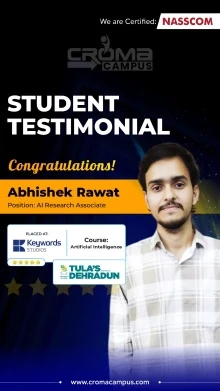
Abhishek Rawat

career upgrade

SELF ASSESSMENT

Learn, Grow & Test your skill with Online Assessment Exam to
achieve your Certification Goals

right-selfassimage
Get exclusive
access to career resources
upon completion
quote
Mock Session

You will get certificate after
completion of program

laptop
LMS Learning

You will get certificate after
completion of program

star
Career Support

You will get certificate after
completion of program

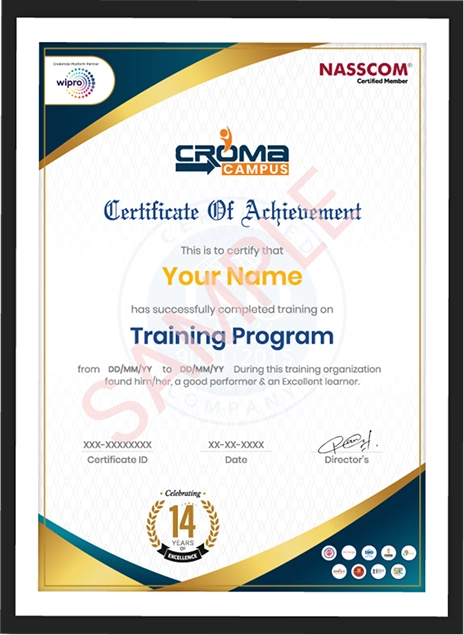
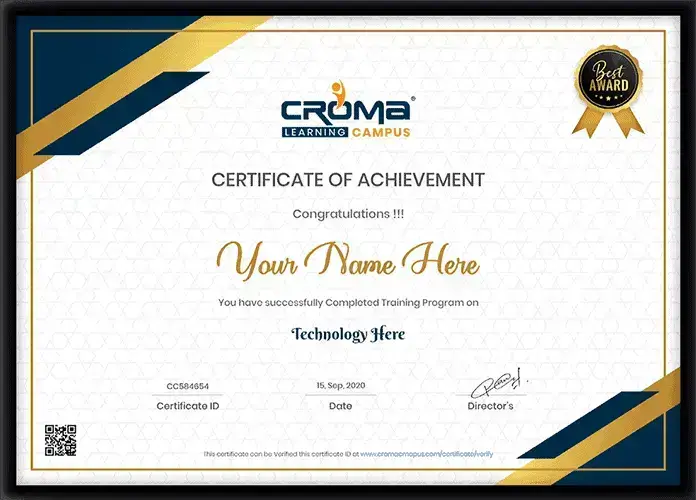
Showcase your Course Completion Certificate to Recruiters

  • checkgreenTraining Certificate is Govern By 12 Global Associations.

  • checkgreen1Training Certificate is Powered by “Wipro DICE ID”
  • checkgreen2Training Certificate is Powered by "Verifiable Skill Credentials"

in Collaboration with

dot-line
Certificate-new-file

Not Just Studying

We’re Doing Much More!

Empowering Learning Through Real Experiences and Innovation

Mock Interviews

Prepare & Practice for real-life job interviews by joining the Mock Interviews drive at Croma Campus and learn to perform with confidence with our expert team.Not sure of Interview environments? Don’t worry, our team will familiarize you and help you in giving your best shot even under heavy pressures.Our Mock Interviews are conducted by trailblazing industry-experts having years of experience and they will surely help you to improve your chances of getting hired in real.
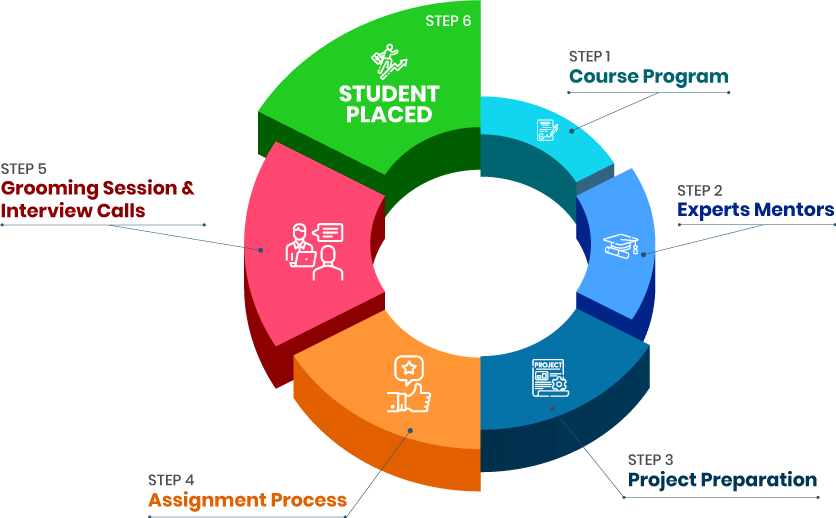
How Croma Campus Mock Interview Works?graph_new

Not just learning

we train you to get hired.

bag-box-form
Request A Call Back

Phone (For Voice Call):

‪+91-971 152 6942‬

WhatsApp (For Call & Chat):

+919711526942
          

Download Curriculum

Get a peek through the entire curriculum designed that ensures Placement Guidance

Course Design By

nasco wp

Course Offered By

Request Your Batch Now

Ready to streamline Your Process? Submit Your batch request today!

WHAT OUR ALUMNI SAYS ABOUT US

View More arrowicon

Students Placements & Reviews

speaker
Prayojakta
Prayojakta
speaker
Saurav Kumar
Saurav Kumar
speaker
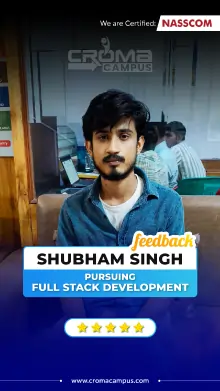
Shubham Singh
Shubham Singh
speaker
Vikash Singh Rana
Vikash Singh Rana
speaker
Deepanshu singh
Deepanshu singh
speaker
Vani
Vani
View More arrowicon

FAQ's

They include Git/GitHub branch management, Jenkins/Maven automated builds, and team workflow best practices.

Yes, advanced modules are dedicated to protecting front-end and back-end endpoints with contemporary authentication and authorization.

Yes, final projects comprise cloud deployment, AWS or Azure hands-on, and Docker containerization.

Yes, special sections discuss TDD, unit/integration testing, and test automation frameworks such as JUnit and Selenium.

Placements cover full stack, backend, DevOps, QA automation, and even product management, aligning with your technical track.

Career Assistancecareer assistance
  • - Build an Impressive Resume
  • - Get Tips from Trainer to Clear Interviews
  • - Attend Mock-Up Interviews with Experts
  • - Get Interviews & Get Hired

Our learners
transformed their careers

highest
35 Laks

Highest Salary Offered

money
50%

Average Salary Hike

building
30K+

Placed in MNC’s

setting
15+

Year’s in Training

alumini
A majority of our alumni

fast-tracked into managerial careers.

Get inspired by their progress in the

Career Growth Report.

FOR VOICE SUPPORT

FOR WHATSAPP SUPPORT

sallerytrendicon1

Get Latest Salary Trends

×

For Voice Call

+91-971 152 6942

For Whatsapp Call & Chat

+91-9711526942
newwhatsapp
1
//