








whatsapppopupnewiconGUIDE ME

Upgrade your skills with practical Java training and become job-ready in the fast-growing IT industry.

4.9 out of 5 based on 55784 votes
google4.2/5
Sulekha4.8/5
Urbonpro4.6/5
Just Dial4.3/5
Fb4.5/5

In collaboration with

80 Hrs.

Duration

Online/Offline

Format

LMS

Life Time Access

Book A Free Counselling Session

we train you to get hired.

bag-box-form
Request more information_

  • Java classes have been the gateway opener for freshers, career changers, and students looking to access the high-speed world of software development. The classes are designed in a simple-to-understand format so that even freshers get a grasp of the powerful language of Java. Irrespective of the kind of desktop applications, websites, or even mobile applications, you would like to create, the Java training Mumbai provides everything one needs to go from dark to penning with convenience. Java training in Mumbai is not learning within a classroom buzzing with theory.
  • Most of the Java classes in Mumbai are a combination of project work, video lectures, doubt clearing, and mentorship from experienced trainers who have some notion of what real IT firms need. For job seekers, becoming a part of a good Java training institute in Mumbai also means having a well-planned roadmap from the first "Hello World" code to profession-fitted professional projects and placements.
    • Java courses in Mumbai online, offline, and hybrid

      Practical Java course in Mumbai offers basics and advanced topics

      Professional Java training in Mumbai for actual job skills

      Career guidance for freshers, career changers, and corporate professionals

      Placement cells at top Java classes in Mumbai with placement

Java Course in Mumbai

About-Us-Course

  • The main objective of any popular Java certification course in Mumbai is to convert curious students into confident programmers. The course teaches everything: Java's history, why it is famous for enterprise applications, how to be logical thinkers, and, lastly, how to create fully-fledged apps and automate business solutions.
    • Mastering Java basics such as variables, loops, conditions, and object-oriented concepts

      Delve deeper into advanced topics: JDBC, collections, multithreading, exception handling

      Create functional applications using the most used Java frameworks

      Prepare and pass the Java certification course in Mumbai for international recognition

      Participate in group projects and coding exercises for in-workplace ability

  • One of the best Java training institutes in Mumbai is known for providing well-designed lessons by industry-approved instructors. There is individual attention provided to each batch through small batch sizes, unlimited online access to course recordings, demo projects, and scheduled tests. Some of the best Java classes in Mumbai with placement have built-in hiring support, which proves to be helpful for students in the highly competitive job market. Mumbai Java course fee is extremely low and negotiable for students, and some even offer payment plans or group discounts.
    • Full hands-on practice on all Java subjects

      Trainers with years of coding experience and hiring background

      Live projects, hackathons, team workshops

      Resume building, soft skills, and interview preparation

      Industry standard certification on course completion

      Transparent Java course fee in Mumbai and easy refund/defer policy

  • Mumbai Java classes for everyone -freshers, BTech/BCA/MCA/engineering students, working professionals, and even non-IT students who wish to develop apps. Learning step by step is made possible through the course structure, and therefore, you don't have to worry about lagging behind. Almost all of Mumbai's Java training centers have no prerequisite specifications just a basic computer course knowledge and a willingness to learn.
    • Any graduate (BCA, BSc, BCom, BA, B.Tech, Diploma) can apply

      No experience and no programming background needed

      Other domain experts can upskill to become dev professionals

      Best suited for candidates who have taken time off to work

      Best suited for both fresher and intermediate students

  • Finishing a Java course in Mumbai is the ticket to a couple of in-demand IT careers: software developer, backend developer, API developer, testing/automation developer, or even Android app developer. Because Mumbai is a financial as well as an IT city, banks to e-commerce organizations are always hunting for new Java skills. Your career pipeline is reached regionally and globally with the help of a Java certification course in Mumbai, where professional shifts and promotions are achievable through next-generation technology trends.
    • How Evolution from SAP HR to SAP SuccessFactors is Benefitting the Businesses

      Java developer, automation tester, mobile app developer

      Spring/Hibernate/J2EE backend specialist

      API/RESTful services implementer

      Higher management and team lead positions after experience

      Such quick forays into IT consulting, technical support, or government jobs

  • Top Java institutes in Mumbai offer a good but comprehensive course. Here's how the experience generally is:
    • Java basics: syntax, data types, loops, operators

      Object-Oriented Programming: classes, inheritance, polymorphism, abstraction

      Exception handling, Input/Output, file operations

      Data structures using Java: arrays, collections framework

      Database integration using JDBC and SQL

      Web application development with Servlets, JSP

      Frameworks: Hibernate, Struts, Spring, Spring Boot

      Deployment of project on servers and development of REST API

      Coding of GUI, event handling, and desktop application basics

      Live project coding and version control/Git

      Exam, certification, and placement training

  • On completion of Java training in Mumbai, students receive certificates issued by the selected Java training institute in Mumbai. High-quality programs ensure course relevance against Java certification courses in Mumbai examination goals (e.g., Oracle OCA/OCP, Spring Framework exams). Such a certificate boosts your CV and provides HR managers with confidence regarding your abilities.

  • It is cost-effective: Java course fees in Mumbai can be anywhere from 28,000 to 79,000 for an intensive Java developer course, depending on duration, training quality, and placement service.
    • Less courses with shorter modules or per-subject fees

      Most Java training in Mumbai colleges provide installment/payment flexibility

      Fees include material, lab practice, and placement guidance

      Bulk/group/corporate discounts are provided occasionally

      Worthy student scholarships

  • The Mumbai Java training freshers can receive 3 lakh to 8 lakh annually; certified/live project-experienced developers can aim for 9 to 12 lakh packages or better. Java training in Mumbai with placement provides mock test guidance, interview preparation, and referrals to best HR partners.
    • Average initial package: 38 lakh per annum

      Higher for career changers/senior programmers

      Higher off-shore/international job opportunities with increased experience/skill level

      Annual increments and performance incentives for project writers

  • After training, most of the students become junior developers. But students of Java certification courses in Mumbai tend to reach team lead, senior developer, or solution architect level within a short time. Most of the others shift later on to other related domains such as cloud, mobile, big data, or QA automation, backed by a solid Java foundation and connections through their Java training institute in Mumbai.
    • Ease of transition from developer to tech lead/architect

      Faster promotions and up-skilling in hip frameworks (Spring Boot, microservices, AWS)

      Access to international jobs/on-site jobs through international recruiter networks

      Facility to establish a freelance or software solutions company

      Life-long mentorship and alumni assistance through career change

  • Mumbai Java classes are the optimal choice since they are a value for money, real-world job outcomes, and work-experience-based project exposure. IT and banking industries are continuously expanding in the city, Java-trained experts always remain sought after. Flexible Java course fees in Mumbai, customized mode, and personal recruitment links make it future-proof and affordable.
    • Good institutes have transparencyno surprise fees, great placement rates

      Peer learning, virtual class discussions, 1-on-1 feedback from instructors

      Regular guest/industry speakers and live coding sessions

      Alumni testimonials who have been placed in India and global firms

  • With a Java certification training in Mumbai, common job titles are backend developer, API/Java engineer, full-stack developer, QA automation/tester, and later tech lead. Responsibilities include writing, optimizing, debugging, testing, and maintaining software running. Project-based interview questions are preferred by most companiesJava classes in Mumbai with placement focus you on those areas.
    • Writing/maintaining clean Java code

      Implementing, designing, and testing business logic

      Working with databases and APIs

      Deploying apps/websites and fixing bugs

      Reviewing peer/team code

      Recording processes and agile task management

  • Java training institute in Mumbai alumni work in IT consulting, banking, digital startups, healthcare, pharma, e-commerce, media, and many others.
    • IT/tech companies and digital agencies

      Banking/finance/insurance (BFSI)

      E-commerce, telecom, and SaaS platforms

      EdTech, gaming, healthcare, and pharma

      System integrators, consulting, mobility startups

  • Our Java training institute in Mumbai is best known for having veterans as instructors, clear Java course fees in Mumbai, learning ease, placement- and project-oriented learning, and the best alumni/placement network. In placement-oriented Java courses in Mumbai, you get a personal roadmapfrom the moment you login to work your first day.
    • Veteran trainers with real-world Java development experience

      Live project work, mock interview practice, hackathons

      Life-long resource and career guidance shortage-free access

      Regular referrals to Mumbais top recruiters and IT firms

      Mentorship, resume/career counseling, and transparent pricing

Why Should You Learn Java?

Not just learning

we train you to get hired.

bag-box-form
Request more information

By registering here, I agree to Croma Campus Terms & Conditions and Privacy Policy

CURRICULUM & PROJECTS

JAVA Training Program

    History and evolution of Java

    Features of Java (Platform Independence, Object-Oriented, Robust, etc.)

    Java Development Kit (JDK), Java Runtime Environment (JRE), and Java Virtual Machine (JVM)

    Setting up Java environment (Installation and configuration)

    Writing and executing your first Java program

Get full course syllabus in your inbox

    Structure of a Java program

    Data types and variables

    Operators (Arithmetic, Relational, Logical, etc.)

    Type Casting

    Input/Output using Scanner and System.out

    Comments in Java

Get full course syllabus in your inbox

    Conditional statements (if, else if, switch)

    Looping statements (for, while, do-while)

    break and continue statements

Get full course syllabus in your inbox

    Arrays (1D, 2D arrays)

    Common array operations

    Introduction to String class

    String methods (concat, substring, equals, length, etc.)

    StringBuffer and StringBuilder classes

Get full course syllabus in your inbox

    Concept of Java Methods

    Parameters and arguments in methods

    Method Overloading and Overriding

    Recursion

Get full course syllabus in your inbox

    Classes and Objects

    Attributes and Methods in Class

    Constructors and destructors

    Modifiers in Java

    Encapsulation

    Inheritance (Single, Multilevel, Hierarchical)

    This, super and final keywords

    Polymorphism

    Inner Class in Java

    Abstraction (Abstract classes and methods)

    Interfaces

    Enums

    Packages

Get full course syllabus in your inbox

    Introduction to Collections

    List, Set, Map, Queue interfaces

    ArrayList, LinkedList, HashSet, HashMap etc.

    Iterators and for-each loop

    Comparable and Comparator interfaces

    Utility classes (Collections and Arrays)

Get full course syllabus in your inbox

    Types of exceptions (checked and unchecked)

    Custom exceptions

    try-catch block with multiple catches

    Nested try blocks and finally clause

    Throwing exceptions using throw

Get full course syllabus in your inbox

    Introduction to Threads

    Creating threads using Thread class and Runnable interface

    Thread lifecycle and states

    Thread synchronization

    Inter-thread communication

    Daemon threads and thread priority

Get full course syllabus in your inbox

    Lambda expressions

    Default and static methods in interfaces

Get full course syllabus in your inbox

    Introduction to Web Development

    • Overview of Web Technologies
    • Difference between Java Servlets and CGI
    • Introduction to Java EE
    • Understanding Web Servers and Application Servers
    • Setting Up the Development Environment (Eclipse/VS Code with plugins)

    Servlet Basics

    • Introduction to Servlets
    • Servlet Lifecycle (init, service, destroy)
    • Writing Your First Servlet
    • Deployment Descriptor (web.xml)
    • Servlet Mapping and URL Patterns
    • Handling GET and POST Requests
    • ServletConfig and ServletContext

    Advanced Servlet Concepts

    • Request Dispatching (forward and include)
    • Session Management (Cookies, HttpSession, URL Rewriting)
    • Servlet Filters (Introduction to Filters, Creating and Configuring Filters, Use Cases: Logging, Authentication, Compression)
    • Error Handling in Servlets
    • Listeners in Servlets (Servlet Request Listener, Http Session Listener, ContextListener)

    Introduction to JSP

    • Understanding JSP and its Advantages
    • JSP vs. Servlets
    • JSP Lifecycle
    • Writing Your First JSP Page
    • Scripting Elements (Scriptlets, Declarations, Expressions)
    • JSP Directives (page, include, taglib)
    • JSP Implicit Objects (request, response, session, application, out, config, page, pageContext)

    Advanced JSP Concepts

    • JSP Actions and Custom Tags (Standard Action Tags-include, forward, param, useBean, setProperty, getProperty), (Introduction to JSTL-JavaServer Pages Standard Tag Library), (Custom Tag Libraries-Creating and Using)
    • Expression Language (EL) (Syntax and Operators, Using EL to Access Data, Implicit Objects in EL, Integrating EL with JSP and JSTL
    • Error Handling in JSP
    • JSP with JavaBeans (Model-View-Controller (MVC) Pattern using JSP and Servlets)

    Integrating JSP and Servlets

    • Passing Data between Servlets and JSP
    • Using JSP as a View Layer
    • MVC Pattern Implementation (Controller {Servlet}, Model {JavaBean}, View {JSP}
    • Application Design with JSP and Servlets

    Deployment

    • Introduction to RESTful Web Services with Servlets (Creating REST APIs using Servlets, JSON and XML Handling)
    • Packaging and Deploying Web Applications (WAR File Structure, Deployment on Tomcat or Other Application Servers)
    • Version Control with Git
    • Performance Optimization Techniques (Caching Strategies, Minimizing HTTP Requests, Lazy Loading Resources)
    • Security Best Practices (Preventing SQL Injection, Cross-Site Scripting (XSS), Cross-Site Request Forgery (CSRF))
Get full course syllabus in your inbox

    Introduction to JDBC

    • Overview of JDBC: What is JDBC, Importance of JDBC in Java applications, JDBC Architecture and API components
    • Setting Up the Environment: (Installing and setting up JDK, Configuring a database (e.g. MySQL), Setting up a development environment (Eclipse, IntelliJ, or VS Code), Adding JDBC driver libraries to the project)

    JDBC Basics

    • Understanding JDBC Drivers:(Types of JDBC drivers (Type 1, Type 2, Type 3, Type 4), Loading and registering JDBC drivers)
    • Connecting to a Database: (JDBC URL, Username, and Password, Establishing a connection using DriverManager, Handling SQLException and understanding error codes)
    • Basic CRUD Operations: (Create: Inserting records using PreparedStatement, Read: Querying records using Statement and ResultSet, Update: Modifying records using PreparedStatement, Delete: Removing records from the database)

    Advanced JDBC Concepts

    • Prepared Statement vs Statement: (Differences between Statement and PreparedStatement, Using PreparedStatement for dynamic queries, Preventing SQL Injection with PreparedStatement)
    • Batch Processing: (Introduction to batch processing, Adding multiple queries to a batch, Executing batch updates for performance optimization)
    • ResultSet: (Navigating the ResultSet (next, previous, absolute, relative), Working with different types of ResultSet (forward-only, scroll-sensitive, scroll-insensitive), Retrieving data from a ResultSet, Updating a ResultSet and reflecting changes in the database)

    Transaction Management

    • Introduction to Transactions: (What is a transaction, ACID properties-Atomicity, Consistency, Isolation, Durability)
    • Managing Transactions in JDBC:(Auto-commit mode in JDBC, Manually handling transactions with commit() and rollback(), Savepoints in transactions, Handling transaction isolation levels (READ_UNCOMMITTED, READ_COMMITTED, REPEATABLE_READ, SERIALIZABLE)

    Advanced Database Operations

    • Callable Statement: (Calling stored procedures and functions, Passing IN and OUT parameters, Handling CallableStatement results)
    • Handling Large Objects (LOBs): (Storing and retrieving BLOBs (Binary Large Objects) and CLOBs, (Character Large Objects), Managing large data efficiently in JDBC)

    Connection Pooling

    • Introduction to Connection Pooling: (What is connection pooling, Benefits of using a connection pool
    • Implementing Connection Pooling: (Setting up Apache DBCP for connection pooling, Configuring connection pool parameters (e.g., pool size, timeout))

    Error Handling in JDBC

    • Error Handling in JDBC: (Understanding SQLException and SQLWarning, Handling SQL exceptions, Logging and debugging database operations, Resource management (closing connections, statements, and result sets), Avoiding common pitfalls (e.g., SQL Injection, inefficient queries))

    Security in JDBC Applications

    • Preventing SQL Injection: (Understanding SQL Injection attacks, Using PreparedStatement to prevent SQL Injection, Validating and sanitizing user input)

    Deployment of JDBC

    • Packaging and Deploying JDBC Applications: (Creating executable JARs with JDBC dependencies, Configuring databases for production environments, Best practices for deploying JDBC applications in production)
    • Maintaining and Scaling JDBC Applications: (Monitoring database connections and performance, Scaling applications to handle larger databases, Planning for database migrations and upgrades, Analyzing and optimizing query performance, Efficient use of indexes and query optimization, Profiling and monitoring JDBC performance)
Get full course syllabus in your inbox

    Introduction to Hibernate

    • What is Hibernate
      • Overview of Object-Relational Mapping (ORM).
      • Benefits of using Hibernate over JDBC.
    • Setting Up Hibernate
      • Installing Hibernate and setting up a basic Java project.
      • Adding Hibernate dependencies (Maven/Gradle).
      • Configuring Hibernate with hibernate.cfg.xml.
Get full course syllabus in your inbox

    Introduction to Spring Framework

    • Overview of Spring Framework
    • Importance and Benefits of Spring
    • Core Components of Spring
    • Setting up a Spring Project

    Spring Core Concepts

    • Inversion of Control (IoC) and Dependency Injection (DI)
      • Understanding IoC and DI
      • Configuring Beans in Spring
      • Spring IoC Container and Application Context
    • Spring Beans and Scopes
      • Bean Lifecycle
      • Bean Scopes (Singleton, Prototype, etc.)
      • Bean Factory vs. ApplicationContext
    • Spring Configuration
      • XML Configuration
      • Java-based Configuration
      • Annotations-based Configuration
Get full course syllabus in your inbox

+ More Lessons

Course Design By

naswipro

Nasscom & Wipro

Course Offered By

croma-orange

Croma Campus

Real

star

Stories

success

inspiration

person

Abhishek

career upgrade

person

Upasana Singh

career upgrade

person

Shashank

career upgrade

person

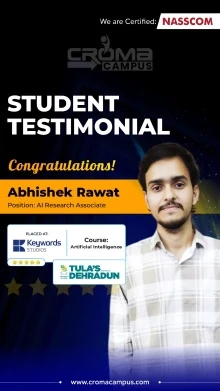
Abhishek Rawat

career upgrade

SELF ASSESSMENT

Learn, Grow & Test your skill with Online Assessment Exam to
achieve your Certification Goals

right-selfassimage
Get exclusive
access to career resources
upon completion
quote
Mock Session

You will get certificate after
completion of program

laptop
LMS Learning

You will get certificate after
completion of program

star
Career Support

You will get certificate after
completion of program

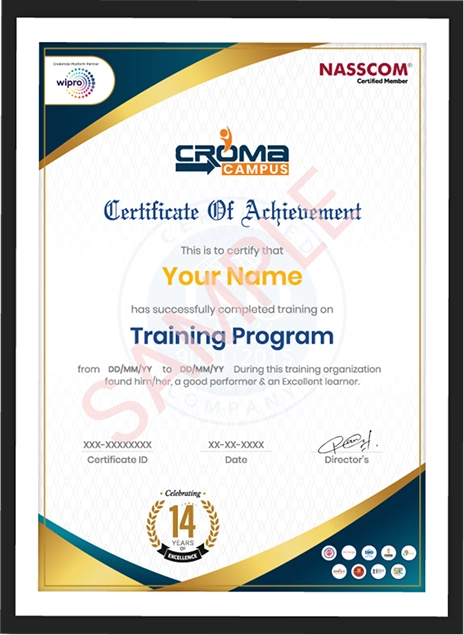
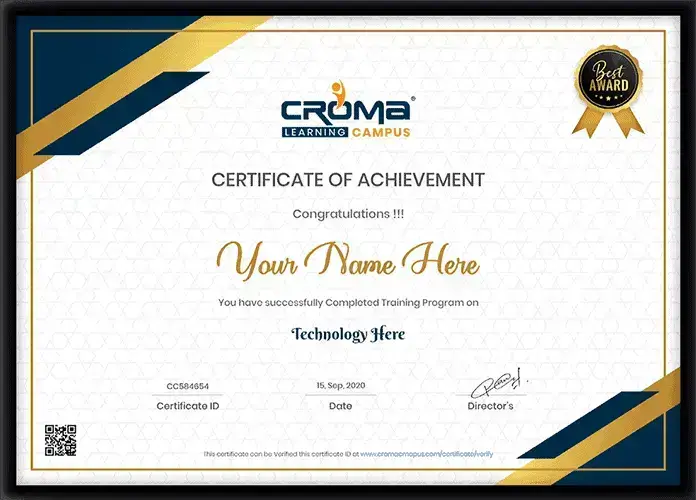
Showcase your Course Completion Certificate to Recruiters

  • checkgreenTraining Certificate is Govern By 12 Global Associations.

  • checkgreen1Training Certificate is Powered by “Wipro DICE ID”
  • checkgreen2Training Certificate is Powered by "Verifiable Skill Credentials"

in Collaboration with

dot-line
Certificate-new-file

Not Just Studying

We’re Doing Much More!

Empowering Learning Through Real Experiences and Innovation

Mock Interviews

Prepare & Practice for real-life job interviews by joining the Mock Interviews drive at Croma Campus and learn to perform with confidence with our expert team.Not sure of Interview environments? Don’t worry, our team will familiarize you and help you in giving your best shot even under heavy pressures.Our Mock Interviews are conducted by trailblazing industry-experts having years of experience and they will surely help you to improve your chances of getting hired in real.
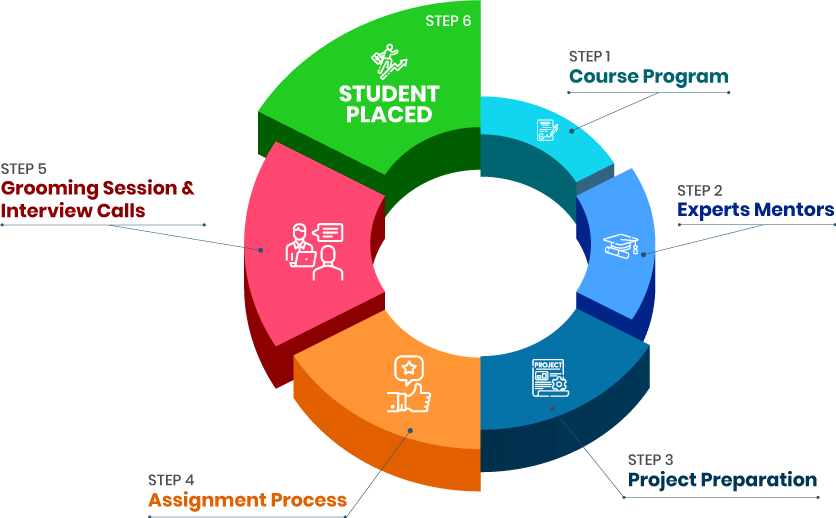
How Croma Campus Mock Interview Works?graph_new

Not just learning

we train you to get hired.

bag-box-form
Request A Call Back

Phone (For Voice Call):

‪+91-971 152 6942‬

WhatsApp (For Call & Chat):

+919711526942
          

Download Curriculum

Get a peek through the entire curriculum designed that ensures Placement Guidance

Course Design By

nasco wp

Course Offered By

Request Your Batch Now

Ready to streamline Your Process? Submit Your batch request today!

WHAT OUR ALUMNI SAYS ABOUT US

View More arrowicon

Students Placements & Reviews

speaker
Prayojakta
Prayojakta
speaker
Shubham Singh
Shubham Singh
speaker
Kapil Sharma
Kapil Sharma
speaker
Sanchit Nuhal
Sanchit Nuhal
speaker
Poonam-Sharma
Poonam-Sharma
speaker
Jayad Chaurasiya
Jayad Chaurasiya
View More arrowicon

FAQ's

Lessons are packed with live demos, code reviews from industry projects, and guest lectures from developers working on Mumbai-based teams.

Some institutes conduct codefests, group projects, and "bug bounty" days to acclimatize the students to real-world collaborative work, leadership, and timely debugging situations.

Current Java training in Mumbai deals with introductory concepts about running Java with Docker, cloud providers, and RESTful microservices.

Almost all of Java training in Mumbai is provided with add-ons of Python basics, web frameworks, agile/Scrum, or automation basics, so your resume covers both backend and "cool" technology—more career options for you.

Career Assistancecareer assistance
  • - Build an Impressive Resume
  • - Get Tips from Trainer to Clear Interviews
  • - Attend Mock-Up Interviews with Experts
  • - Get Interviews & Get Hired

Our learners
transformed their careers

highest
35 Laks

Highest Salary Offered

money
50%

Average Salary Hike

building
30K+

Placed in MNC’s

setting
15+

Year’s in Training

alumini
A majority of our alumni

fast-tracked into managerial careers.

Get inspired by their progress in the

Career Growth Report.

FOR VOICE SUPPORT

FOR WHATSAPP SUPPORT

sallerytrendicon1

Get Latest Salary Trends

×

For Voice Call

+91-971 152 6942

For Whatsapp Call & Chat

+91-9711526942
newwhatsapp
1
//