.svg)














 Training Certificate is Govern By 12 Global Associations.







 Career Transition
 Career Gap
 Placement Activities
 Placement Drives
 Latest Hiring
 Whats App Reviews
.webp)

.webp)



.jpg)

.jpg)

.jpg)
Course Design By
Nasscom & Wipro
 GUIDE ME
If you are a beginner or a professional who wants to learn the whole process of automation of the software development.This AWS DevOps Certification Course covers some of the main areas like Continuous Integration & Monitoring, Security, Automation and Deployment.
 4.2/5
4.2/5 4.8/5
4.8/5 4.6/5
4.6/5 4.3/5
4.3/5 4.5/5
4.5/5In collaboration with

Online/Offline
Format
LMS
Life Time Access
we train you to get hired.

Offer complete awareness of AWS services utilized in DevOps
Educate automation using CloudFormation, Terraform, and Ansible
Describe CI/CD pipelines in AWS using Jenkins and CodePipeline
Discuss containerization tools: Docker, ECS, and Kubernetes EKS
Hands-on serverless development with AWS Lambda
Risk management via role-based IAM security
Real-time monitoring using CloudWatch and X-Ray
Blue/Green deployment strategies for production updates
Optimize auto-scaling policies and load balancing
Preparation for the AWS Certified devops Engineer Training exam modules
Git & Jenkins pipelines with AWS CodePipeline
CloudFormation and Terraform automation of builds and deployment
Fargate for serverless containers with ECS container orchestration
Microservices automation with Kubernetes EKS clusters
Provisioning serverless APIs with AWS Lambda + API Gateway
IAM-based roles and security boundaries for DevOps pipelines
CloudWatch metrics and alarms with automated rollback
Artifacts management with AWS CodeBuild and CodeDeploy
Log analysis for production troubleshooting (CloudTrail, CloudWatch Logs)
Hybrid DevOps configurations bridging on-premises infrastructure
Automate CI/CD for web applications with Jenkins and AWS services
Create CloudFormation templates for enterprise-scale architecture
Deploy containers with ECS and Kubernetes EKS
Execute monitoring dashboards in CloudWatch with alarms
Create rollback workflows on failed deployments
Set up Blue/Green deployments for low downtime updates
Create serverless backend APIs using Lambda and DynamoDB
Set up Auto Scaling for traffic surge simulations
Secure DevOps pipelines using IAM and policy configurations
Beginning AWS DevOps practitioner: 5 to 8 LPA
Certified engineer (2 to 5 yrs): 10 to 16 LPA
Senior AWS DevOps experts (5 to 9 yrs): 18 to 22 LPA
Cloud/DevOps Architect (>10 yrs): 25 to 30 LPA
Experts experience 80100% hikes after certification
DevOps Expert Lead AWS DevOps Consultant
Cloud Architect Cloud Engineer Enterprise Automation Specialist
Site Reliability Engineer (SRE) career path
Cloud-native DevOps Security Consultant positions
AWS consulting projects all over the world
Enterprise Agile/DevOps Culture Coach positions
AWS Cloud is natively integrated with DevOps lifecycle phases
Financial savings from auto-scaling and automation
Improved software delivery speed at enterprise levels
Microservice orchestration for fast dev cycles
Worldwide acceptance of AWS certification for DevOps professionals
Ever-growing demand owing to AWS leadership in cloud space
Design and orchestrate CI/CD pipelines at scale
Automate infrastructure with IaC (CloudFormation, Terraform, Ansible)
Orchestrate containers with ECS/EKS for microservices
Setup Blue/Green and Canary releases
Enforce secure IAM policies for pipelines
Integrate high-level monitoring with CloudWatch metrics
Offer troubleshooting on production issues
Optimize workloads with auto-scaling and cost controls
Ensure compliance with enterprise standards
IT Consulting and MNC companies (Accenture, Cognizant, Deloitte)
Banking and Financial Services (cloud-native compliance)
E-commerce and retail entities (scalability-demand)
Healthcare and insurance for compliance workloads
Telecom businesses for billing/call routing automation
Energy and Manufacturing for hybrid DevOps operations
we train you to get hired.
By registering here, I agree to Croma Campus Terms & Conditions and Privacy Policy
+ More Lessons
Course Design By
Nasscom & Wipro
Course Offered By
Croma Campus
Stories
success
inspiration
career upgrade
career upgrade
career upgrade
career upgrade
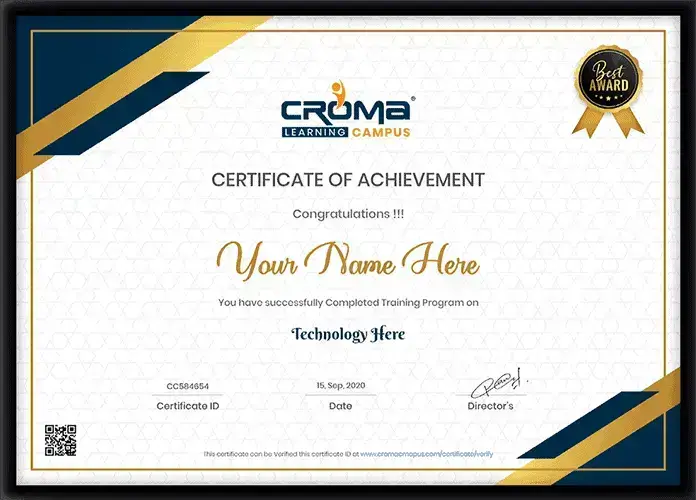
You will get certificate after
completion of program
You will get certificate after
completion of program
You will get certificate after
completion of program
in Collaboration with
Empowering Learning Through Real Experiences and Innovation
we train you to get hired.
Phone (For Voice Call):
+91-828 706 0032WhatsApp (For Call & Chat):
+91-828 706 0032Get a peek through the entire curriculum designed that ensures Placement Guidance
Course Design By
Course Offered By
Ready to streamline Your Process? Submit Your batch request today!
An AWS Certified DevOps Engineer is responsible for implementing and managing continuous integration and deployment pipelines, automating infrastructure, and optimizing AWS environments for scalability and reliability.
To become an AWS-certified DevOps Engineer professional, you need to pass the AWS Certified DevOps Engineer – Professional exam, demonstrating your expertise in designing and managing AWS solutions for DevOps practices.
The cost of AWS DevOps Engineer certification varies by exam level and location, with the AWS Certified DevOps Engineer – Professional exam typically costing around USD 300.
Prerequisites for AWS Certified DevOps Engineer certification include prior experience with AWS services, proficiency in DevOps methodologies, and knowledge of scripting languages like Python or Ruby.
The cost of AWS DevOps certification in India may vary, but generally, the exam fee for the AWS Certified DevOps Engineer – Professional exam is around INR 21,000*.
AWS DevOps certification validates your expertise in cloud-based DevOps practices, enhancing your credibility and opening doors to higher-paying roles and career advancement opportunities in cloud computing and DevOps fields.
Yes, students create failover simulations using Route53 and RDS multi-AZ in the lab.
Recorded classes, weekend batch schedules, and 24/7 access to the cloud lab are provided.
Yes. Beginners are welcome, however some basic knowledge of AWS would be good, the course will cover everything in depth.
You will need a basic knowledge of scripting but you don’t need to be an expert of programming.
You will learn CI/CD, automation, monitoring, IaC, deployments, logging, and security, with AWS.
Yep. This AWS DevOps Certification Training is aimed for both freshers and professionals.
You might look at AWS DevOps Engineer, Cloud Engineer, DevOps consultant, Site Reliability Engineer and Cloud Ops Engineer jobs.
It is a certification program that assesses the candidate's ability to create, deliver, operate and manage distributed applications in the AWS environment through the DevOps approach. This test concentrates more on automation, continuous delivery, infrastructure management, monitoring, security and optimization of AWS resources.
With the help of AWS CloudFormation, one can apply IaC (Infrastructure as Code) approach and deploy needed infrastructure based on the templates with the definitions of the necessary AWS resources. In other words, there will be no need to do anything manually anymore.
The choice of the correct strategy depends on various aspects like application criticality, requirements to availability, risk tolerance, etc. An AWS DevOps engineer must be aware of the following deployment strategies: • Blue-Green Deployment: Having two environments, traffic is switched between old and new versions. • Canary Deployment: At first, a new version is deployed to some percent of users and then rolled out. • Rolling Deployment: Old instances are replaced with the new version gradually. • All-at-Once Deployment: A new version is applied to the whole at once.
Amazon CloudWatch can be used for the following purposes of DevOps engineers: metric monitoring, logging, event handling, creating dashboards, setting up alarms and triggering automated actions related to monitoring and observability of AWS applications and infrastructure.
AWS Systems Manager enables you to manage and automate operations tasks in the AWS environment. The tasks could be patch management, parameter management, configuration management, automation, and remote management.
Security should not be considered the last aspect to consider but should instead form an integral part of the whole software development lifecycle. There are certain AWS services that one may leverage in order to make security an integral part of the DevOps lifecycle such as IAM, AWS Secrets Manager, AWS KMS, AWS CloudTrail, encryption, security, and vulnerability tests, among others.
Amazon ECS is a service offered by Amazon for deploying and managing containerized applications while Amazon EKS is a managed Kubernetes service by AWS. Such services can be leveraged in DevOps practices for automating the deployment, management, and scaling of containerized applications.
Thanks to the usage of the serverless computing on events, AWS Lambda can offer various use cases of DevOps that include automation of tasks, deployment-related tasks, validation, operations scripts, event processing, and even components of the serverless application.
IaC in the AWS DevOps approaches refers to the method where the infrastructure can be configured and managed by the teams via machine-readable configuration files.
With the help of deployment automation and monitoring along with predefined conditions of failure, automated rollback is possible. AWS services such as AWS CodeDeploy and Amazon CloudWatch can be integrated into deployment alarms and release pipelines in order to spot problems and automate rollback to previous versions of applications.
AWS has a number of features which may allow creating highly available applications and infrastructure. Such features include Availability Zones, Elastic Load Balancing, Auto Scaling, fault tolerance architecture, automated deployment, health monitoring and automated recovery procedures. By utilizing all of these features alongside with effective DevOps practices one can reduce downtime significantly.
The candidate preparing for this exam should obtain practical experience in several DevOps and AWS domains, namely: • Implementation and automation of CI/CD • Infrastructure as code • AWS infrastructure management • Monitoring and observability • Logging and troubleshooting • Cloud security and IAM • Networking basics • Containerization and orchestration • Serverless architectures • Deployment and releases • Automated operations and rollback • Configuration and systems management • High availability


Highest Salary Offered

Average Salary Hike

Placed in MNC’s

Year’s in Training

fast-tracked into managerial careers.
Get inspired by their progress in the
Career Growth Report.
FOR QUERIES, FEEDBACK OR ASSISTANCE
Best of support with us
Share some of your details and we will be in touch with you for demo details, and know about Batches Available with us!
By registering here, I agree to Croma Campus Terms & Conditions and Privacy Policy


For Voice Call
+91-971 152 6942For Whatsapp Call & Chat
+91-9711526942Share some of your details and we will be in touch with you for demo details, and know about Batches Available with us!



.jpg)













.webp)















































.webp)































































 +91-828 706 0032
 +91-828 706 0032



 +91-828 706 0032
 +1 (782) 819-0044





 Interested in Course?



.webp)
.webp)

.png)


